• The Big Picture
  • Here’s ScottNerd…
  • Here’s DerekNerd…

Images and Nerds

~ We're turning pages–and writing about them!

Images and Nerds

Author Archives: dmainhart

I&Nterview: Danny Fingeroth

16 Tuesday Jul 2013

Posted by dmainhart in I&Nterview

≈ Leave a comment

Tags

A Contract with God, Alain Resnais, All Things Considered, Alter Ego, Chris Claremont, Danny Fingeroth, Dean Haspiel, Dennis O'Neil, Disguised as Clark Kent: Jews Comics and the Creation of the Superhero, Fredric Wertham, Harvey Pekar, Hilde Mosse, Jack Kirby, Jason, Joey Cavalieri, Klaus Janson, Last Year at Marienbad, Leila Corman, Marvel, Marvel Comics: The Untold Story, memoirs, Miriam Katin, MoCCA, NPR, Peter Kuper, Rick Geary, Robert Crumb, Roy Thomas, Sean Howe, Seth, Silver Surfer, Society of Illustrators, Spider-Man, Stan Lee, superheroes, Superman on the Couch: What Superheroes Really Tell Us about Ourselves and Our Society, The Rough Guide to Graphic Novels., The SoHo Gallery for Digital Art, The Stan Lee Universe, The Today Show, TwoMorrows Publishing, Unterzakhn, WhirlGirl, Will Eisner, Write Now!

Danny Fingeroth is a man who’s made his life in comics. Best known as the longtime editor of Marvel’s Spider-Man comics line, Danny is also something of an academic authority on the form. His impressive contributions to the underlying power of the medium include such well-received books as: Superman on the Couch: What Superheroes Really Tell Us about Ourselves and Our Society; Disguised as Clark Kent: Jews, Comics and the Creation of the Superhero; and The Rough Guide to Graphic Novels. He created and edited Write Now!, a magazine dedicated to the craft of writing comics. In a similar vein, he has taught comics-related courses at New York University, The New School and The Museum of Comic and Cartoon Art (MoCCA). He has spoken on the subject at The Smithsonian Institute and The Metropolitan Museum of Art and has appeared on NPR’s All Things Considered and The Today Show on NBC. He currently offers classes and educational programs at The SoHo Gallery for Digital Art. His most recent book (co-edited with fellow legend Roy Thomas) is The Stan Lee Universe.

Derek Mainhart: You’ve delved quite a bit into the autobiographical subtext of a lot of comics, especially regarding the original superhero comics of the early 20th Century. What got you thinking along these terms?

Danny Fingeroth: It’s something I just gravitate toward thinking about. Sure, these stories were created to generate revenue, but with that as a given, what were they about under the spandex trappings? Why THESE stories and characters, and not others?  When you start thinking about that, pretty soon you’re getting to “What were the creators—including the editors—trying to express? What personal experiences, yearnings, dreams, did they draw on?”

DM: Interesting that you mention the editors; they often get overlooked in questions like this. To what degree do you think editors influenced some of the autobiographical subtext we’re talking about?

DF: Editors often become part of the creative process, especially in mainstream comics, since you are often dealing in a shared universe. Every comic and every team deals with this differently. Ultimately, the editor is concerned with, “What will sell the most comics while also preserving the long term integrity of the main characters?” (Business imperatives may dictate how much concern is evidenced for those long term concerns.) So if a story ultimately becomes a combination of ideas and experiences from the various parties concerned in making the story, then that’s fine, at least as far as the long term health of the character franchise, if not for the egos of all concerned. Just as a TV series can be the “vision” of one or multiple minds, the same with a comics series. The editor is supposed to not take credit for the creative content, but if you find yourself liking multiple titles, on an ongoing basis, that are edited by a specific person, then you have to think that, at the very least, that editor is catalyzing these particular creators into working at the top of their game, even if he or she is not specifically directing them regarding what to do and how to do it.

DM: What would you say the comics written by Danny Fingeroth reveal about him?

DF: That’s not really for me to say. Let a thousand doctoral theses be launched! (Or at least a couple of blog posts.)

DM: On the other side of the coin, you’ve written about society’s need for superheroes. Do you think they have a shelf life? The heroic figures of the 19th Century, for example, don’t necessarily carry the same weight as they did in their own time (Sherlock Holmes being, perhaps, an exception). Even the pulp heroes that begat superheroes, while still around, are hardly the phenomena that they once were. Could it be said that, in terms of comics, the 20th Century was the Superhero Century, and that the 21st will perhaps move on to Something Else? Or have waves of blockbuster movies enshrined them in the popular consciousness?

DF: The latter. As our society seems to become more complex than ever (is that an illusion?), people tend to want simple, direct solutions to these problems in their entertainment. Superheroes, even complex ones, fill that bill. The superhero has become for the 2000s what the Western was for the 20th Century—a metaphor system through which Americans tell ourselves our collective story.

Behind the Scenes

DM: Sean Howe’s book Marvel Comics: The Untold Story recently garnered some attention. Naturally, you make a couple of appearances. Would you say his behind-the-scenes look at Marvel’s history paints an accurate picture? Is there anything in it you’d care to comment on?

DF: I’d say given the enormity of the task Sean took on, he did a good job of weaving the company’s history into a narrative with a compelling flow. There is no single “Marvel,” after all. Everyone who worked there experienced it differently. I think Sean delved into some of what was going on behind the scenes over the years with a reasonable amount of accuracy. The hardest thing to convey in a biography of a company is the reality that, while people come together at a place for a common cause, they/we all have our own non-work lives going on at the same time. That’s where personal memoirs would come in. What non-work-related reasons were there for why a particular person made a series of decisions? Who were they when they left the office for the day? How did that affect the work they produced?

DM: How do you think the job of an editor has changed in the last 15 years or so?

DF: It seems pretty much the same to me. I think the replacement of the phone call with e-mail and other electronic communication media is problematic when applied to a creative field. As in most areas of life, communication is now quicker, and while in some ways clearer, in other ways more confusing. We’re probably now at a similar point where, 100 years ago, people were bemoaning the impersonal nature of the phone call. Now we yearn for the shades of meaning that can be conveyed by an actual human voice over a phone. But the roles of an editor as representing the company to the creators and the creators to the company seem to me to be pretty constant.

DM: What about the role of an editor as representing the company and creators to the public/fan base? How important is it to have a presence on social media, for example?

DF: Social media is an accelerated, intensified version of the letters page, and convention interaction which editors and creators used to interact with the public in the pre-digital era. Readers and fans (not always the same thing) may think they want to see a particular character’s saga develop in a certain way, but the fact is that what people want is to be surprised by something that in retrospect was inevitable–which is the definition of a good story. Ultimately, in non-gaming, non-fanfic narratives, we want to see the characters we have an emotional investment in do amazing things that are awesome and cool–but that also make sense given what we know about the characters and their worlds. So social media can serve to help get a more immediate sense of what the readership likes and doesn’t like, or what surprises they may have figured out before you wanted them to–but ultimately, just as they want to hear a singer sing, they want to have the storytellers tell them the best possible stories. Social media helps that process along.  

DM: The fanboy/geek in me has to ask: the Spider-Man line is currently involved in a controversial storyline. Your run as editor on Spider-Man was no stranger to controversy itself. Is there any advice you could give to Spidey’s current editorial crew?

DF: Listen to all advice, but keep your own counsel. If the fan inside you says “I gotta read that!”—then do it!

Memoir-able

DM: In The Rough Guide to Graphic Novels, your top three choices are memoirs, and your top ten is rounded out by books that are at least partly autobiographical in nature. Is there something inherent in the medium that lends itself to this type of personal narrative?

DF: I think so. There’s something so direct and visceral about comics.  The medium can convey complexities of human experience that are simultaneously “realistic” and yet also subjective, and do it in a way that neither print nor film/video can.

DM: How much of this autobiographical strain do you think can be traced back to the “first” graphic novel, Will Eisner’s A Contract with God?

DF: I think it goes back at least as far as Crumb, who often told stories that were from his own life, and then to Harvey Pekar, who refined autobiography to a high level, often with Crumb illustrating. Eisner added a distancing layer by lightly fictionalizing his characters’ names and likenesses. Being of a different generation with a different orientation toward comics, Eisner’s stuff was a synthesis of what he had done over the previous decades, along his realization that adults who enjoyed comics might actually want material that deals with more mature themes and concerns.  Of course, storytellers have been mixing autobiography with fiction forever. Even in Contract and his other work that is considered autobiographical, Eisner is very careful to use fictional street names and somewhat disguised characters, so what seems like memoir is fictionalized.

DM: TRGtGN was published in 2008. Anything since then crack your list of must-reads?

DF: Jason and Seth are pretty fantastic. So are Miriam Katin, Dean Haspiel, and Peter Kuper. Leila Corman’s Unterzakhn was great. Rick Geary’s body of work is astonishing.

And Now for Something Completely Different…

DM: Whatever happened to WhirlGirl?

DF: She hasn’t gone away. More info when and if something happens…

Stan the Man

DM: What was the impetus behind Write Now! ?

DF: I wanted to demystify comics writing and to get it some respect. Also, I wanted people to get some sense of how it’s done and make them think about how they might be able to write comics of whatever type, for the major companies, or 20 of their friends. Art is “sexier” than writing because its appeal is visceral and often immediate, whereas writing takes a little more time and effort to judge and respond to—at least it seems that way on the surface. After all, writing and art combine to make comics, so how can you really separate the two crafts, anyway?

DM: Was putting together The Stan Lee Universe a natural outgrowth of your experience on Write Now! ?

DF: Well, it started as the simple idea to combine my and Roy Thomas’s 85th birthday tributes to Stan from Write Now and Alter Ego magazines. Then it got a whole lot more complicated when we decided that I would travel to Stan’s archives at the University of Wyoming and see what unique material I could find there. And I found lots!!

 DM: Sounds potentially fascinating. Anything you can share?

DF: I found recordings of radio interviews that were broadcast in the 1960s and then never heard again. I had the best of them transcribed and then lightly edited them, and they appear in the book. There’s a lengthy one of Stan with Jack Kirby from 1967, which is fascinating. Then there’s one from 1968, the week after Nixon was elected president, of Stan debating comics-hating Fredric Wertham’s colleague, psychiatrist Hilde Mosse, about comics and popular culture.

DM: Wow.

DF: There’re also pages from the screenplay Stan wrote in the early ’70s for a film that was to be directed by his friend, French director Alain Resnais, who made Last Year at Marienbad, among many classics, and is still making important movies.

DM: Tres avant garde

DF: Plus, there’s a lot of script and pencil art from the 1978 Silver Surfer graphic novel Lee and Kirby did, including many personal notes and comments from both of them. Those are just a few of the incredible things in the book. It’s pretty amazing stuff. I’d love to do a volume two. 

DM: Stan projects a very strong public image. Without giving anything away, did editing all of those interviews from various points in Stan’s life give you some new insight into the intersection of his life and work? The man behind the persona?

DF: I learned that he gives the world more glimpses behind that public persona than is immediately obvious, because he often couches remarkably frank statements within the context of other material that is more purely promotional or entertaining. His public persona, in my experience, isn’t that different from the private one—just louder.

From Behind the Scenes to In Front of a Blackboard

DM: The classes you put together for MoCCA over the years featured an impressive roster of talent (Chris Claremont, Dennis O’Neil, etc). Had any of them taught before?

DF: Dennis had taught for many years at SVA. Ditto for Joey Cavalieri and Klaus Janson. I think at some point most comics creators have done at least a guest shot in a class or been on a panel at a convention. For those with less teaching experience, I would do the lesson as an interview I was conducting with them. Don’t forget, in pitching a story, one uses many of the same skills a teacher uses: conveying an idea clearly and in a compelling manner to someone else. I would generally try to choose people to teach whom I knew had an engaging conversational style, and who were excited about sharing ideas. They were teaching already, even if they weren’t aware that they were.

DM: Any thoughts on MoCCA’s absorption by the Society of Illustrators?

DF: I’m glad MoCCA is surviving and thriving. I’m a big fan of both organizations.

DM: Anything else in the works?

DF: I’m working on several book and comics projects that I hope to be able to speak about in more detail soon. Ditto for events and classes that I’ll be giving live and online. I can tell you that I’ll be teaching my comics writing online class again through The Media Bistro website in the fall, and teaching a comics writing course for undergrads through the department of TV and Radio at Brooklyn College, also in the fall.

DM: What advice would you give to prospective comics creators (other than to take your classes!)?

DF: Don’t do just one thing. Be an artist, not just a comics artist. Be a writer, not just a comics writer. Comics careers are for the most part relatively short, even for people whose talent is acclaimed and in demand. Even if you have a twenty-year comics career, you still have another twenty, thirty, forty or more years of a working life in which you’ll want to stay active and productive.   
 

Share this:

  • Click to share on X (Opens in new window) X
  • Click to share on Facebook (Opens in new window) Facebook
  • Click to share on Tumblr (Opens in new window) Tumblr
  • Click to share on Reddit (Opens in new window) Reddit
  • Click to email a link to a friend (Opens in new window) Email
  • Click to share on Pinterest (Opens in new window) Pinterest
Like Loading...

Back & Forth: Gorilla/War

04 Thursday Jul 2013

Posted by dmainhart in Back and Forth

≈ Leave a comment

Tags

30 Days of Night, All-New X-Men, Battlefields, BOOM!, Breath of Bones: A Tale of the Golem, Brian Michael Bendis, Captain America, Criminal Macabre, Dark Horse, Dave Wacher, Doug Murray, Enrico Fermi, Fightin' Marines, Fury: My War Gone By, Garth Ennis, Heart Shaped Box, IDW, Image, Jason Ciaramelia, Jeff Stokely, Joe Hill, Jonathan Hickman, Kurt Vonnegut, Locke and Key, Marvel, Nick Fury, Nick Pitarra, Noel Sickles, Saga, Samuel Jackson, Saving Private Ryan, Sergio Leone, Sgt. Fury and his Howling Commandos, Simon Spurrier, Six-Gun Gorilla, Steve Niles, Steven Spielberg, The Manhattan Projects, The' Nam, Thumbprint, Uncanny X-Men, Vic Malhotra, war comics, Weird War Tales, Will Eisner

Derek Mainhart: One of the things about the current comics landscape that we here at I&N are really excited about is the sheer variety of material being produced: comedy, drama, memoir, romance, crime, horror, etc. I’ve said it before: if you can’t find something that appeals to you, it’s because you aren’t looking. Having said that, given the reality of the world since 2001, it’s perhaps surprising that there’s been a relative dearth of one particular genre: war comics. So, as we celebrate the birth of our nation, we thought it appropriate to revisit this neglected corner of the comics store.

The heyday of war comics naturally began with WWII. Captain America famously punched Hitler in the face. The heroic exploits of our men in uniform filled the pages of titles like Fightin’ Marines and Sgt. Fury and his Howling Commandos (that’s right; long before Samuel Jackson’s ultra-cool portrayal of the man at the helm of flying CGI aircraft carrier, Nick Fury was a regular-army fightin’ grunt.) Through the ’50s and ’60s newsstands were replete with tales of grit, patriotism and sacrifice. Their popularity waned however to the point that in the ’70s the most notable war book was almost unrecognizable as such: Weird War Tales (emphasis on the Weird). It was perhaps inevitable that the genre should fade under the shadow of Vietnam. It is somewhat ironic then that the one significant war comic of the ’80s was The ‘Nam. Doug Murray’s fictionalized account of the Vietnam War, drawn partially from his own experiences, was remarkable both for the way it tackled its difficult subject matter as well as for being published by a mainstream publisher like Marvel, of all places. Lately, as we’ve previously noted, Garth Ennis seems to be single-handedly reviving the genre with his superlative Battlefields series, as well as his surprising Fury: My War Gone By, in which he brings the aforementioned Nick Fury back to his combat roots and then proceeds to make him witness and participant to the litany of American military misdeeds following “the good war”.

Well, happily, if this week’s books are any indication, Ennis has some company in the trenches:

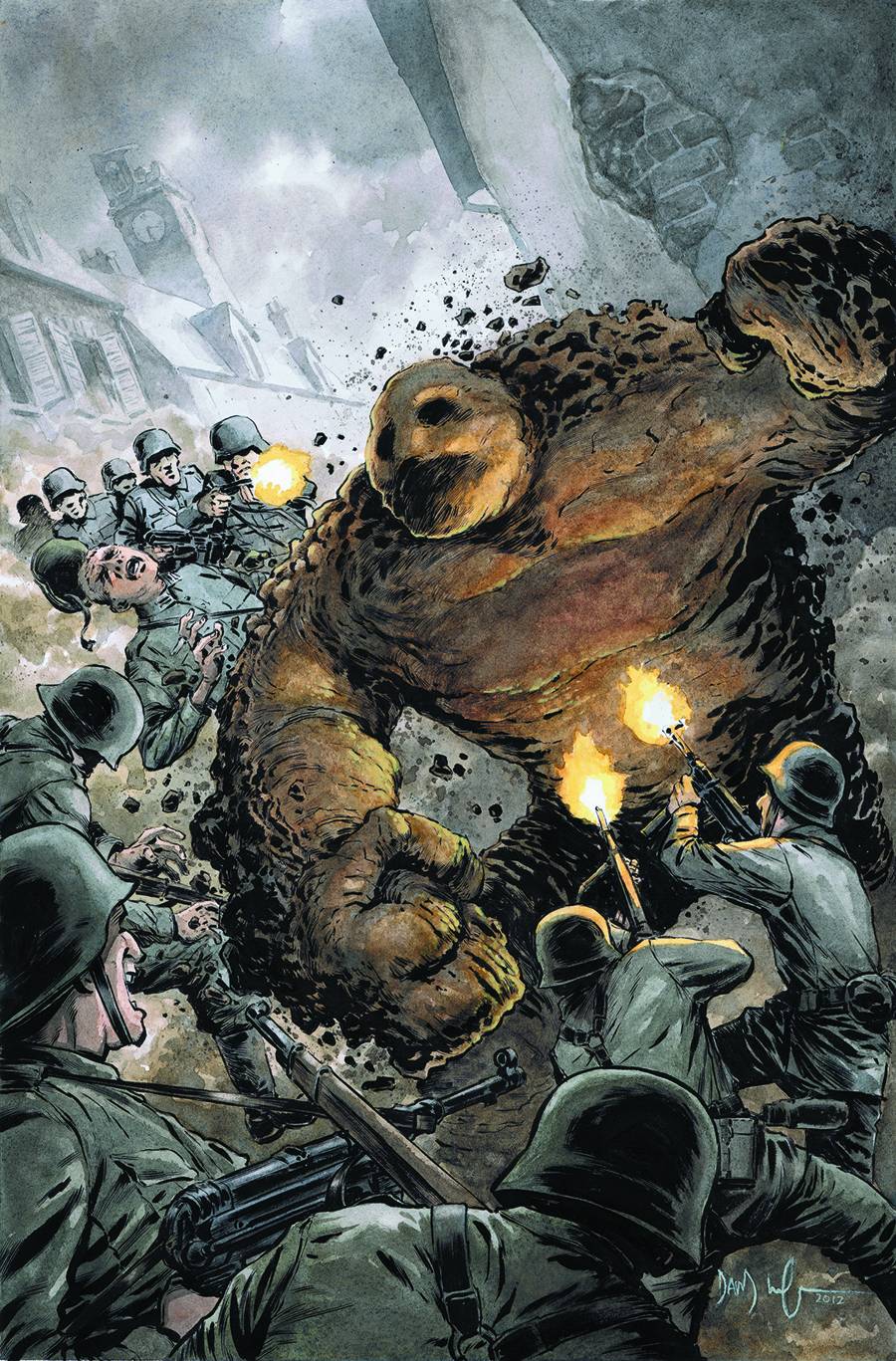
We begin, not surprisingly, in WWII, our most eulogized of conflicts, where the lines of good and evil were, it seems, so clearly delineated. This contrast is literally, beautifully rendered in black and white in Breath of Bones: A Tale of the Golem #1 (Dark Horse) by Steve Niles and Dave Wachter.

Breath of Bones: A Tale of the Golem #1

Breath of Bones: A Tale of the Golem #1

Scott Carney: Yeah, the storytelling here is a cut above.  The aforementioned pair–and it’s a magical pair, indeed–harvests horror and hope in an temperately-paced issue that plays out as a promise: evil will get its comeuppance.  Noah and his grandfather–generational bookends–are another magical pair, one that personifies the perpetual struggle between wonder and wisdom, which plays out tenderly–affected by the soft lines Wachter employs throughout, especially to craft the grandfather’s expressive countenance–during the debate over what to do with the downed RAF pilot and as the grandfather entrusts the means to salvation to his grandson with an aphorism that teaches the boy a grim reality: “sometimes it takes monsters to stop monsters.”

DM: Niles, best known for clever, over-the-top horror fare such as 30 Days of Night and Criminal Macabre, here displays a more heartfelt touch, especially, as you mention, in the boy’s relationship with his grandfather, but also in his stoic denial, and then acceptance, of his father’s fate. This is echoed by the quiet dread of a village that fears it is doomed by the encroaching forces of war – a fear that, sadly, always has currency, somewhere in the world. And Wacher’s truly remarkable art recalls not only the great Will Eisner’s later work, but even work from further afield – dare I mention Noel Sickles?

SC: While The Manhattan Projects (Image) delivers a tender turn in issue #11, in #12 masterminds Jonathan Hickman and Nick Pitarra return tender to sender and unleash the monster–the one that has been exploiting Enrico Fermi’s identity all this time in order observe humanity–particularly to discover its capabilities as it pertains to some “out of this world things.”

The Manhattan Projects #12

The Manhattan Projects #12

Throughout the book, we’re treated to “drone” Enrico’s backstory, which, outside of how he came to be, clues us into the “other side” of scenes we’ve already encountered; I particularly enjoyed the flashback decked out with a dialogue overlay, which adds a dimension to the drama that unfolded during the scout team’s assault on the Siill, as initially seen in issue #5.  (For those keeping score: a similar strategy was recently employed–effectively so–by Brian Michael Bendis in a mini-crossover of sorts between All-New X-Men #10 and Uncanny X-Men #4.)  As the tragic tale of Enrico Fermi comes to a close, it’s worth noting that, despite the drone’s programmed prerogative, there remains a hint of humanity in the monster; but all the apologies in the world cannot save it from the monster meant to mete out final justice in this instance: a marvelously maniacal Einstein with a chainsaw cleverly tagged with E=MC^2.  My goodness!  Has the Cold War ever been any hotter than this?

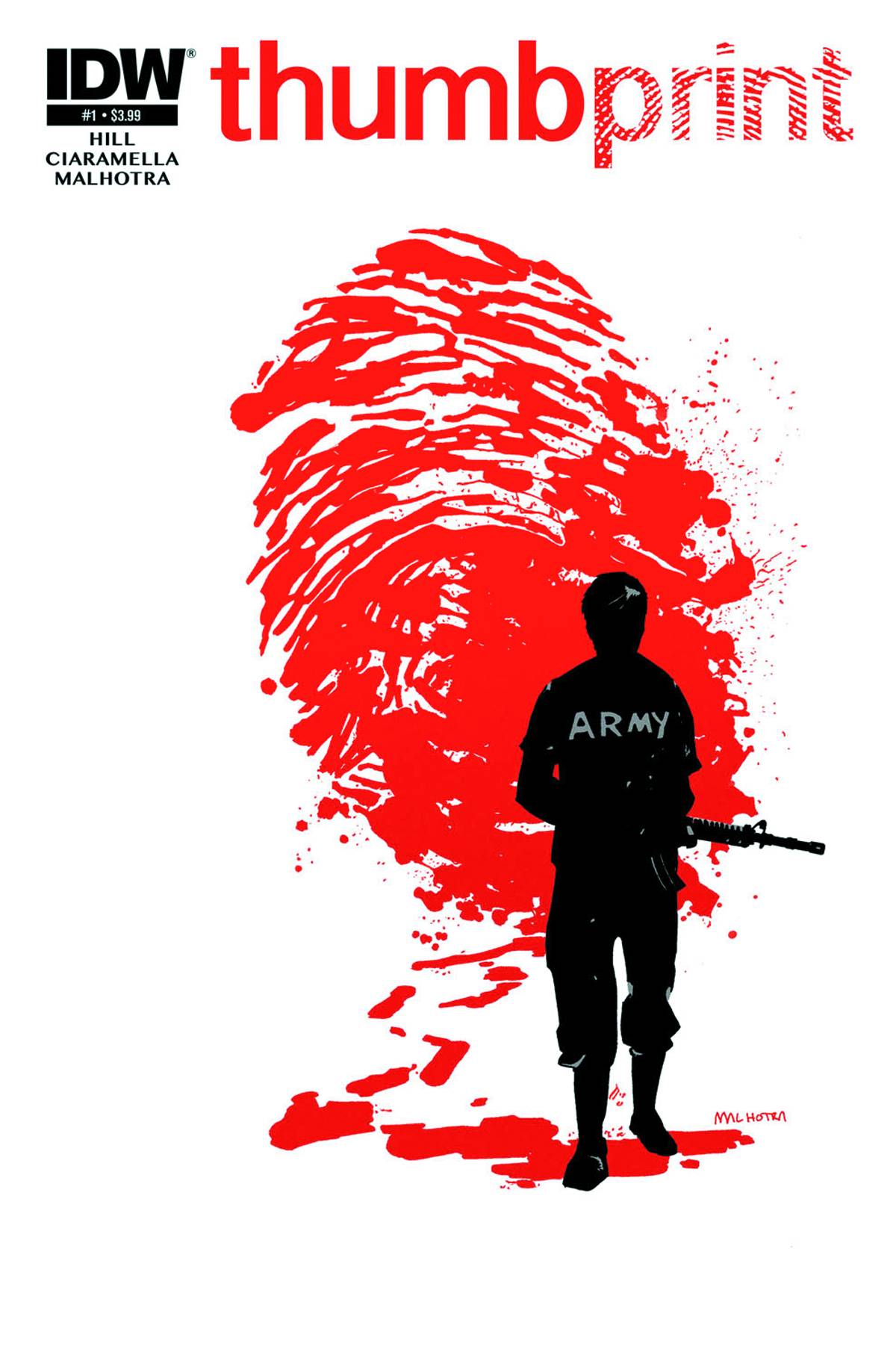
Thumbprint #1 (IDW), based on Joe Hill’s novella of the same name and brought to the page by Jason Ciaramella and Vic Malhotra, is a well wrought thriller that exploits the more recent and far more politically polarizing Iraq War–specifically the moral suicide that was Abu Ghraib–as a backdrop for one vet’s struggle to reacclimate herself to her far less complicated life in New York, where the problems she’s facing are almost farcical considering what she dealt with and what she did in the infamous prison.  Yeah, it’s all par for the course for someone in her situation, really–until she receives by mysterious means a couple of thumbprints: one that triggers a flashback of a routine “soften[ing] up” of a prisoner at Abu Ghriab and another that really seems to soften her up a bit.

DM: Hill, who’s already proven his horror chops in comics (Locke and Key) and prose (Heart Shaped Box) here combines both worlds via an excellent adaptation by Ciaramelia and Malhotra. He’s taken the horror trope of the single, isolated damsel in distress and successfully turned it on its head; readers’ natural predisposition to root for her are tempered, if not wholly undercut, by the knowledge of her wartime actions. She may very well deserve whatever’s coming to her! Talk about “sometimes it takes monsters to stop monsters”!

SC: She responds to this faceless intimidation by carelessly casting threats to the wind–threats that she may very well be able to back up with the gun she’s got; I mean, she handles herself well enough with the all-too-handy John Perry, right?  But it’s clear: her bluster belies her vulnerability; it screams she’s scared.  Hell, after that last page, I know I am!

Thumbprint #1

Thumbprint #1

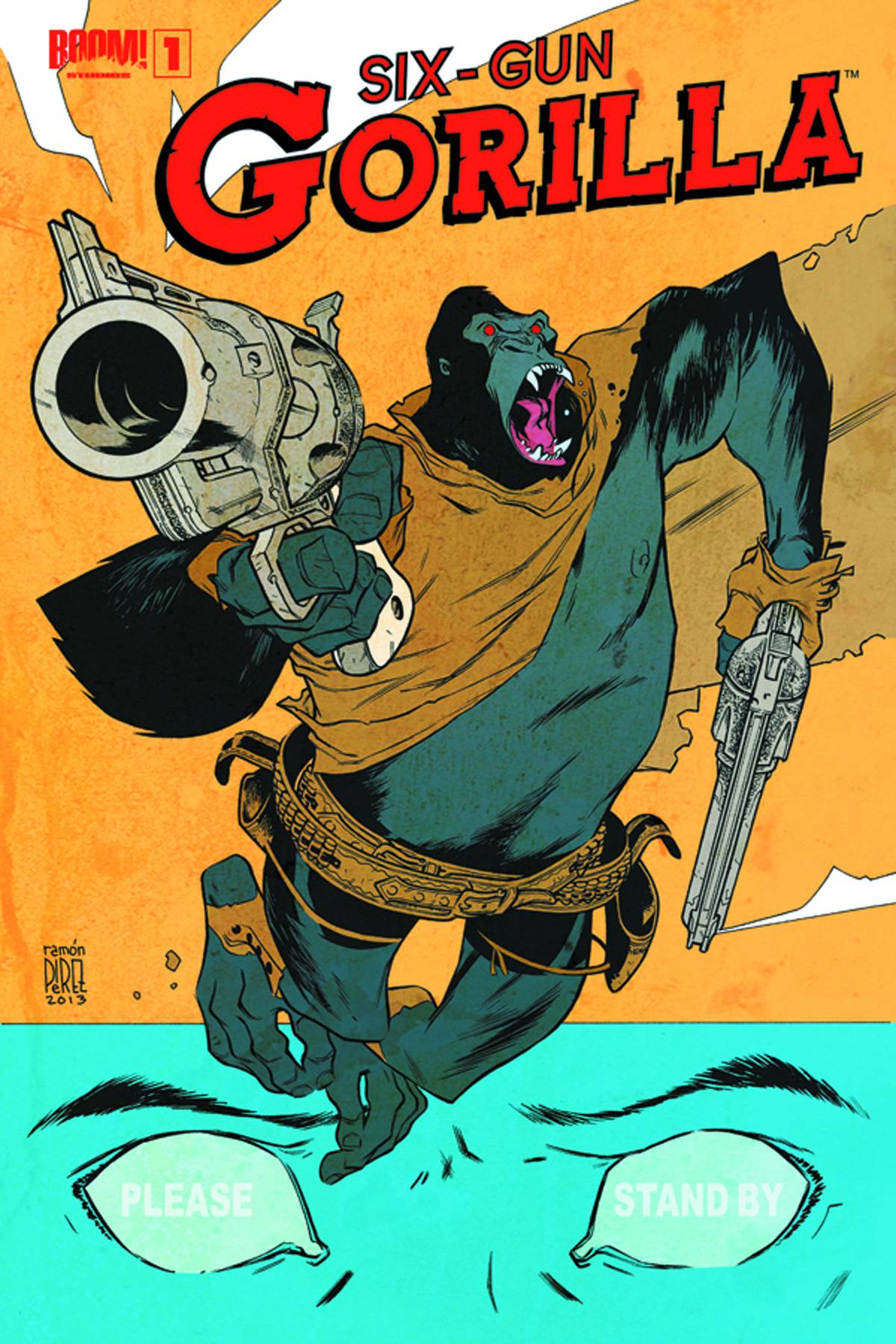
SC: But as good as those books are–and they’re really good–not a one can stand up to Six-Gun Gorilla #1 (BOOM!).  I’d be lying if I said I expected that to be the case.  I pretty much picked it up because of its being a #1 and, well, yeah, that and because of the promise of the title; I mean, let’s be honest, great apes and guns are the Reese’s of comics.  Yes, the prospect of some sort of shenanigans starring a side-armed simian guided my first few page turns.  But I found myself going bananas over one primate-free panel after another; and in that, it became clear: killa gorilla or no, this book is as fun as a bored-out barrel full of monkeys!

DM: The whirling dervish of a plot, from the mind of Simon Spurrier, involves a soldier, known only as “the Librarian,” who’s volunteered for a suicide mission on a faraway desolate planet. The Deal? He and the other members of his unit have been promised a big pay-out to their loved ones back on earth if and when they die in battle. The Twist? (SPOILER ALERT!)  They’re not fighting for freedom, national defense or any other noble cause; the entire enterprise is being broadcast back home as a reality show, with all the demographic pandering and ad revenue that implies. That’s right, they’re dying for ratings. Now that’s a 21st century war! Spurrier’s story, with its multilayered mishmash of wartime violence, science-fiction conceit, and sharp-eyed satire brings to mind some of Kurt Vonnegut’s work. But thanks to Jeff Stokley’s expansive art, it’s Vonnegut as stylistically filtered through Steven Spielberg in army mode (a chaotic early sequence recalling the opening of Saving Private Ryan) and the desolation of Sergio Leone’s spaghetti westerns. The Result? The most promising sci-fi opening these eyes have seen since Saga. And I haven’t even mentioned that damn, dirty ape…Book of the Week.

Sixth-Gun Gorilla #1

Sixth-Gun Gorilla #1

You’ll have to pry this comic out of our cold, dead hands,

Scott & Derek

Share this:

  • Click to share on X (Opens in new window) X
  • Click to share on Facebook (Opens in new window) Facebook
  • Click to share on Tumblr (Opens in new window) Tumblr
  • Click to share on Reddit (Opens in new window) Reddit
  • Click to email a link to a friend (Opens in new window) Email
  • Click to share on Pinterest (Opens in new window) Pinterest
Like Loading...

Back & Forth: Vacation, all I ever wanted!

21 Friday Jun 2013

Posted by dmainhart in Back and Forth

≈ 2 Comments

Tags

Abstract Studio, Akira, Archer & Armstrong, Area 51, Astro City, Brent Anderson, Craig Cermak, Dark Horse, David Mamet, DC, Dean Motter, Dynamite Entertainment, Fleischer Brothers, Fred Van Lente, Fritz Lang, Garth Ennis, Howard Chaykin, Jimmy Olson, Kirby: Gensis, Kurt Busiek, Little Orphan Annie, Lois Lane, Mister X: Eviction, Pere Perez, Peter Pan, Rachel Rising, Red Team, Richard Connel, Sesame Street, Strangers in Paradise, Terry Moore, The Monster at The End of This Book, The Most Dangerous Game, The Zaucer of Zilk, Valiant, Vertigo

Derek Mainhart: Ah, summer; so close you can practically taste the sunscreen! Naturally your thoughts may be turning toward planning a much-needed getaway. What to do, what to do? Road trip? Um, have you seen the price of gas? Well then, maybe you can fly somewhere…Oh sure! So the folks at the NSA can laugh at your body scan? A cruise perhaps? I’m sorry, have you been watching the news? Well then, you say, why bother leaving the house? That’s the spirit! But fret not, our delicate, sensible reader! Grab your margarita mix, break out your thong and relax while Images and Nerds plans the most fantastic voyage you can have without ever leaving the comfort of your own butt-molded couch cushion.

Astro City #1

Astro City #1

First stop, sunny, scenic Astro City! (DC/Vertigo) After a three-year hiatus, Kurt Busiek’s own private metropolis is back and open for business with a new #1! If this is a return trip to the award-winning series (about a city populated by all manner of super-folk), you won’t be disappointed; illustrated by series co-creator Brent Anderson, it’s as lovely as ever. If, however, this is your first excursion (like it was for your beloved guide), don’t worry; Busiek expertly leads you through the story, giving you just enough information to hint at the wonder and scope of your surroundings, without ever being in danger of getting lost. Busiek has indeed proven a master at synthesizing large swaths of characters and story, both in the previous AC runs as well as the more recent Kirby: Genesis (an impressive homage to the master that is truly worth a second look). Like Kirby, the plot revolves around the sudden, mysterious arrival of a gigantic, god-like, celestial being who delivers a portentous proclamation to the good people of earth. Unlike Kirby, which very much wore its heart on its sleeve, the tone of the new Astro City has a wry, ironic tone. Whether or not this was true of the earlier series, I can’t say. But this sense of remove, heightened by the charming and trippy narrator’s breaking of the fourth wall, reminded this reviewer of last year’s standout, The Zaucer of Zilk. Then there’s that second-to-last page, with its playful exhortations to the reader, putting me in the mind of nothing so much as that Sesame Street classic, The Monster at the End of This Book. Which is to say, this promises to be fun.

Prefer a more secluded spot? How about Area 51? If so, you could hardly do better than Archer and Armstrong #10 (Valiant). Fred Van Lente’s roller coaster of a comic is so jam-packed with demi-gods, evil ghost-parents and of course, aliens, that you may not notice how whip-smart the writing is; the sequence with the pregnant spy alone is worth the price of admission, as is the hostage who is hysterical in more ways than one (poor guy). It then closes with the flat-out funniest Next Issue box I’ve ever seen. And with Pere Perez handling the art, this book’s never looked better. Believe it: the best blockbuster of the summer is a comic book.

Archer & Armstrong #10

Scott Carney: No, no.  You don’t believe in aliens or time travel, do you?  You’re someone who likes to keep it real, right? Yeah, you’re straight up street, son. Check it: why not trip your kicks over to Garth Ennis and Craig Cermak’s Red Team #3 (Dynamite), where the hearts are cold and the gun barrel’s still hot to the touch.  Your itinerary: holy vengeance. We’re talkin’ old school–no, Old Testament vengeance, ya Sodomites; that’s right, happy heathens, you better believe it: the Son of God is sinfully subordinate to the Gun of God, as blasphemously billed by Howard Chaykin’s irreverently rendered cover:

Red Team #3

Oh, yeah, he nailed it! And that gun ironically speaks the loudest–not in tongues but through a tongue: Father McEwan’s newly pierced tongue, to be exact–in an issue otherwise dominated by Ennis’s celebrated signature: damn good dialogue.

DM: I’m glad you mentioned that. One of the criticisms I’ve been hearing about this book is that it’s too “wordy”. This is, of course, patently ridiculous. You don’t hear this sort of charge being leveled in other visual media, like film or television, especially when dealing with a writer with chops like Ennis’.

SC: Speaking of: three issues in, it’s clear that Ennis is bent on bringing his ethically challenged NYPD to Broadway for a sustained run because this book–surprisingly light on action–reads like a David Mamet play: the Irish scribe relies on carefully composed conversation–at times so naturalistic that a second or third glance is necessary–to develop his God–no, not Mod, but God–Squad. So, if you haven’t yet been to the Great White Way–and you’d like to put a little culture in your Petri dish–here’s your ticket!

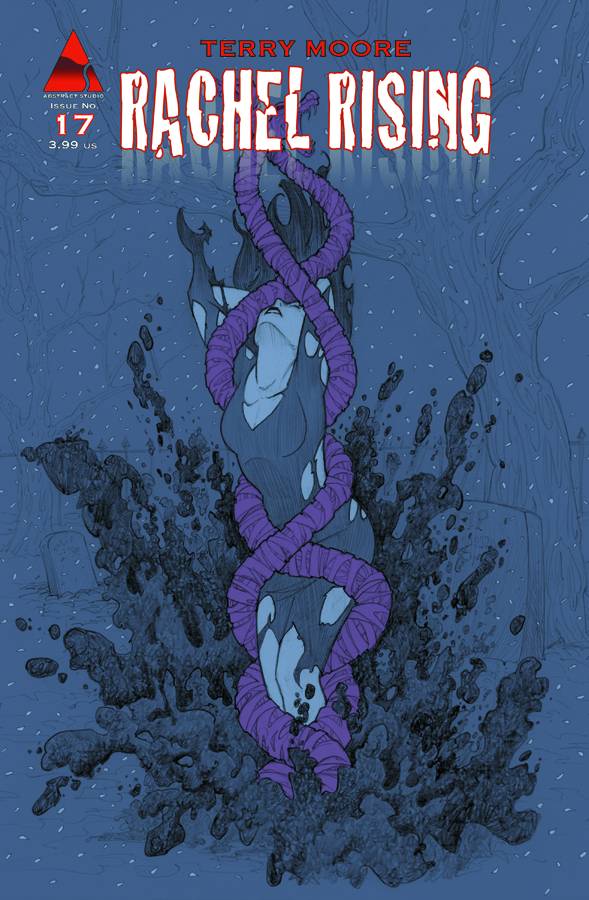
DM: One place you probably shouldn’t visit is the normally picturesque town of Manson. Long ago the site of some Salem-type witch trials, the the current townspeople have recently been plagued by a spate of mysterious deaths, rat-filled plumbing, and at least one case of vomiting a live snake. Ah well, at least the snow is beautiful. Locals whisper of a recently deceased young lady, Rachel, who has returned to solve the mystery of her own murder. With her best friend Jet (also recently deceased) in tow, they delve into a story that grows ever more mythic, even as it becomes more disturbing. Read all about it in Terry Moore’s latest tourist’s pamphlet: Rachel Rising #17 (Abstract Studio). Marvel at the art, including a nice callback to Moore’s previous series, Strangers in Paradise…

SC: Man, that was weird.  At first, I thought it was an ad for an SIP trade or something.  I really liked it, though, especially how Moore shamelessly–and cleverly– worked in the readily recognizable portrait.

DM: …and gasp at the loveliest paean you’re likely to hear about being eaten alive.

SC: Yeah, what I’m hearing is a siren song: the promise of comic book perfection and the ultimate execution–of stereotypical masculinity.  The fairly phallic cover is a beautiful warning of the dangers that lie ahead for men.

Rachel Rising #17

Rachel Rising #17

This town, Manson–get it: man and son–is not very accommodating to men at all; it’s certainly not a place les hommes can comfortably call home; so proceed with caution, my brothers.  I mean, think about it: hunters–who often employ domesticated dogs to point out or fetch their quarry, just not in this case–are generally considered the epitome of manliness, you know, with their killing stuff with lead-launching extensions of their manhood and whatnot; but here, in a little slice of Richard Connell’s “The Most Dangerous Game,” the hunters–not so surprisingly, considering the fiercely feminine tone of the book–become the hunted: the witches wield their power here, unleashing a pair of wild wolves, which they so wickedly command, and showing the misogynist dunderheads who’s boss.  This, friends, is a real No Man’s Land.

Ah, but could there be a more welcoming city–a finer final destination–than Radiant City, the seemingly sentient setting of Dean Motter’s Mister X: Eviction #2 (Dark Horse)?  Once there, hit the local bars, get caught in traffic, get yourself kidnapped–heck, leap from rooftop to rooftop!  Why not?  It’s all up to you!  But if you’re looking for a truly arresting time, have they got the club for you.  It’s called Purgatorium, and it’s got everything: blind guys and no I’s, mugshots and robots, heartbreaking and head shaving, and a lady who looks a hell of a lot like Mister X.

DM: It’s also got a backup story, again by Motter, that loosely ties into the lead; that’s right, you get two trips for the price of one! Talk about economical! Befitting its retro-futurist style, this featurette showcases an intrepid reporter with a knack for getting into trouble getting rescued by a gang of classic, 1930’s-style orphans. The plot, involving the orphan’s home being threatened with destruction by “pilotless drones” (in the form of giant, mechanized robots, natch!), offers subtle, wry commentary on current American military tactics. But the real draw here is the way Motter is able to touch upon so many nostalgia-laden pop-culture motifs in such a small space: Little Orphan Annie, Lois Lane and Jimmy Olson, Peter Pan, even a little Akira. The effect is like a Fleischer cartoon as directed by Fritz Lang. The title of this piece? Rosetta Stone, Girl Reporter in Little Urchin Andy. What comics fan wouldn’t love that? Book of the Week.

Mister X: Eviction #2

Bon Voyage,

Scott and Derek

Share this:

  • Click to share on X (Opens in new window) X
  • Click to share on Facebook (Opens in new window) Facebook
  • Click to share on Tumblr (Opens in new window) Tumblr
  • Click to share on Reddit (Opens in new window) Reddit
  • Click to email a link to a friend (Opens in new window) Email
  • Click to share on Pinterest (Opens in new window) Pinterest
Like Loading...

Catch-Up Time!

01 Saturday Jun 2013

Posted by dmainhart in Microviews

≈ Leave a comment

OK kiddies, it’s been a while. This whole “real life” thing sure eats up a lot of time! (Apparently babies need things like “attention” and “food”) But I’ve been able to carve out some time by giving up sleeping and showering, so here are some highlights from the past couple o’ weeks:

Dream Thief #1 (Dark Horse): “What would you do if you woke up in a strange room and didn’t know where you were, or what you’d done the night before to get there?” This is the question, rife with metaphysical implications and narrative possibility, that writer Jai Nitz asks, repeatedly, in the first issue of this promising new miniseries. Or rather, his lead character, John Lincoln, does. Lincoln is an unrepentant  philanderer, thief and all-around lowlife, enlivened by Nitz’s ear for snappy, noir-ish dialogue (John may be heartless, but at least he’s funny). Following his own worst impulses, John comes into possession of a mystical aboriginal mask. The mask somehow connects him to the recently murdered, whom he then seemingly avenges while he’s still asleep. Needless to say, when John wakes up, he finds himself in all sorts of interesting situations. Nitz has created a tightly structured narrative that keeps looping in on itself, heightening the sense of intrigue and possibility. Equally impressive is the way Nitz and artist and letterer Greg Smallwood employ the graphic language of comics in telling their story; insert panels that also function as x-rays, “see-through” sound effects that don’t cover up the action, but rather, emphasize it, and giant punctuation utilized as panel design. Smallwood grabs you not only with his moody drawing style, but with his bold overall aesthetic; this is a great looking book. Moreover, the design smartly reinforces the repetition in the story, as the lead character keeps awakening to new, ever-more-unnerving situations. It’s like Inception, by way of Will Eisner’s The Spirit, with a little bit of The Mask thrown in. These are all good things. If you passed it by the first time, go back and give it a second look.

page from Dream Thief #1

Revival #10 (Image): This has always been a middle-of-the-stack book for me; solid, workmanlike, mostly dependable entertainment, but only rarely exceptional. It’s the type of book I read but rarely feel the need to write about (right alongside titles like Clone, Wonder Woman and Helheim, to name a few). In fact I nearly dropped this comic a couple of months ago after a particularly uninspired installment. Well this issue makes me glad I stuck around. In the past, the various strands of Tim Seeley’s narrative (involving the sudden return of some recently deceased folks in a small town) threatened, at times, to get away from him. Some threads seemed extraneous, or just plain uninteresting, taking precious panels away from exploring the more fascinating aspects of his story. This time out, however, all the pieces click. Seeley performs a hell of a juggling act, cutting and intercutting the various fragments in a way that finally feels cohesive in both mood and plot, with all the pieces moving toward one purpose. The dialogue, which occasionally veered toward the ham-handed in the past, is believable and engaging (that last line!). Seeley is ably abetted by Mike Norton’s reliably strong (and in one instance, memorably grotesque) visuals. As they expertly send their unknowing players careening toward each other, Seeley and Norton have created a feeling all too rare in horror: genuine suspense.

Regular readers of this space (all eight of you) probably won’t be surprised though, that my favorite book of the past couple of weeks was Adventure Time with Fionna and Cake #5 (kaboom!). I’ve been raving about Natasha Allegri’s mini-masterpiece pretty much from the start. This has less to do with my general captivation of the Adventure Time franchise (no, really) than with the innovative way Allegri is playing with it. Simply by switching the genders of the main players in the fairy-tale land of Adventure Time, Allegri has allowed herself room to play with and subvert any number of tropes from familiar sources such as Cinderella and Rapunzel, not to mention that modern staple of girls’ movies: the makeover. None of this comes across as an overt paean to ‘girl power’. That part’s understood. Instead Allegri’s light touch sacrifices none of the action, violence and thrills of the yarn while simultaneously reminding us of the charm of sugar, spice and everything nice.

Adventure Time with Fionna & Cake #5

What tickled your fancy the past few weeks?

Turning Pages,

Derek

Share this:

  • Click to share on X (Opens in new window) X
  • Click to share on Facebook (Opens in new window) Facebook
  • Click to share on Tumblr (Opens in new window) Tumblr
  • Click to share on Reddit (Opens in new window) Reddit
  • Click to email a link to a friend (Opens in new window) Email
  • Click to share on Pinterest (Opens in new window) Pinterest
Like Loading...

Top 5 Books of March 2013 – The Best of Times?

14 Sunday Apr 2013

Posted by dmainhart in 5 Comics You Should Be Reading

≈ Leave a comment

Tags

Adventure Time with Fionna & Cake, Animal Man, Battlefields, Brian K. Vaughan, Buddy Cops, Dark Horse, DC, Ed Brubaker, Eric Stephenson, Evan Shaner, Fatale, Fiona Staples, Fonografiks, Garth Ennis, IDW, Image, J. Bone, kaboom!, My?tery Society, Natasha Allegri, Nate Bellegarde, Nate Cosby, New 52, Nowhere Men, Roger Langridge, Saga, The Answer, The Rocketeer: Hollywood Horror

Folks, if you don’t already know, it’s a great time to be reading comics. Take this month’s list for example: when stalwarts like Garth Ennis’s Battlefields and Ed Brubaker’s Fatale don’t even crack the top five (not to mention such left field surprises as My?tery Society and The Answer!) you know it’s been some good readin’. Dare I suggest we’re witnessing a second Golden Age?

5. Adventure Time with Fionna and Cake #3 (kaboom!): Natasha Allegri’s delectable delight is not exactly subversive, like a dessert laden with liquor, but it is a multi-layered cake. It can be gulped down, with childlike ravenousness, as the super-fun fairy tale that is. Or it can be slowly digested as a knowing commentary on gender roles. Or better yet, both. Bon Appetit. (DM)

4. Buddy Cops (Dark Horse): To kinda quote the Clan: “[Nate Cosby] be tossin’, enforcin’, [his] style is awesome/[Evan Shaner’s] causin’ more Family Feuds than Richard Dawson/And the survey said–[if ya didn’t think Buddy Cops was friggin’ hilarious,] ya [must be] dead.” (SC–with a little help from RZA)

3. The Rocketeer: Hollywood Horror #2 (IDW): Pulp heroes tearing it up in the golden age of Hollywood? Really, what more could you ask for? Roger Langridge and J Bone’s ode to nostalgia earns the label “classic” on every level. A dream for comics fans and movie fans. (DM)

2. Nowhere Men #4 (Image): Complex storytelling, beautiful art and sophisticated design: Eric Stephenson, Nate Bellegarde and Fonografiks’ tale of science gone awry in a retro-mod near future is a sleek, finely-tuned, precision vehicle. If “science is the new rock n’ roll” then this is the coolest book on the stands. (DM)

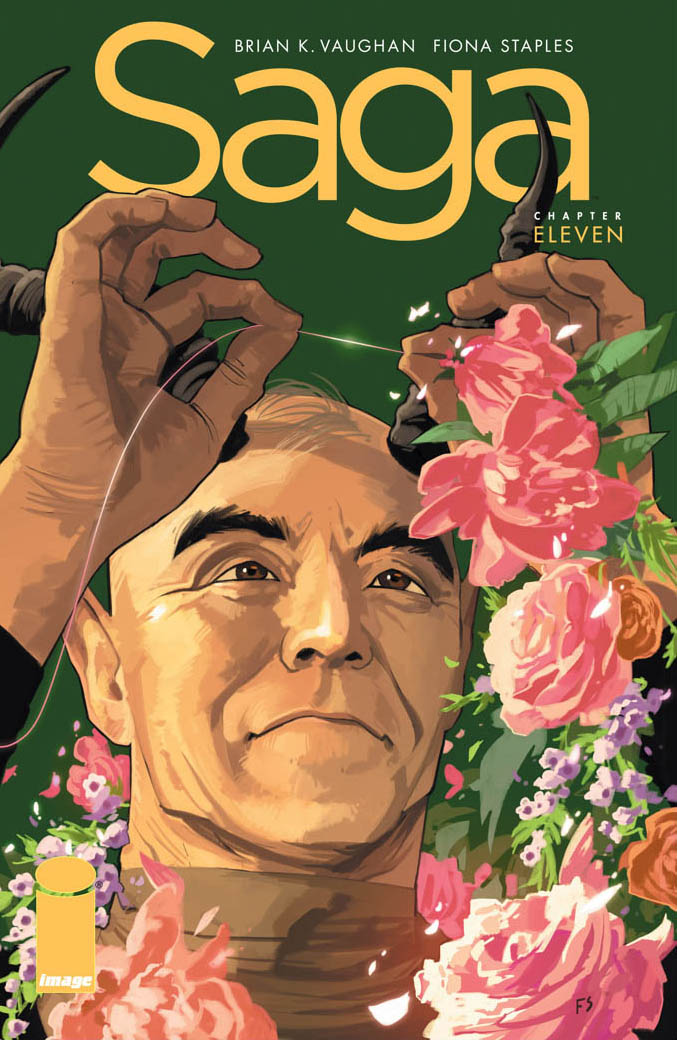
1. Saga #11 (Image): A stunning piece of storytelling from Brian K. Vaughn and Fiona Staples.  Over the course of eleven issues, they’ve managed to assemble the most relatable cast of characters in comics; and that unparalleled ensemble is put to the test in this emotionally charged issue of sex, love, sacrifice, and death.  There isn’t another book being published that can touch it.  I thank God I get to–every four weeks or so.  (SC)

The Biggest Dis(appointment): Animal Man #18 (DC) –  “The most tragic day in the life of Buddy Baker”?  OK.  If you say so.  In fact, you had to say so because, as the story unfolded, I felt absolutely nothing of tragedy–except maybe the very tragic pangs of disappointment.  In the end, my expectations for this title–which had been on life support after #17–were killed along with Cliff, himself a mini Animal Man, playing the role of the simply unnecessary sacrificial lamb. (SC)

But let’s accentuate the positive: this month’s Top 5 represent a wild variety of storytelling, genre and art that affirms and re-affirms our love of the medium. We share these books because they are the ones that excited us this month. So what’s your Top 5?  Share it with us. Or spread the word and tell a friend. Like we said, it’s a great time to be reading comics.

Turning pages,

Scott & Derek

Share this:

  • Click to share on X (Opens in new window) X
  • Click to share on Facebook (Opens in new window) Facebook
  • Click to share on Tumblr (Opens in new window) Tumblr
  • Click to share on Reddit (Opens in new window) Reddit
  • Click to email a link to a friend (Opens in new window) Email
  • Click to share on Pinterest (Opens in new window) Pinterest
Like Loading...

Back & Forth: Hail the Future Heroes of Yesteryear!

26 Tuesday Mar 2013

Posted by dmainhart in Back and Forth

≈ Leave a comment

Tags

2001: A Space Odyssey, 48 Hours, Adventure Time, Archer & Armstrong, Betty Page, Bravest Warriors, Buddy Cops, Chris Samnee, Cliff Secord, Dark Horse Comics, Darwyn Cooke, Dave Stevens, Dirty Money, Emanuela Lupacchino, Eric Stephenson, Evan Shaner, Fab Four, Fantastic Four, Fonografiks, Fred the Clown, Fred Van Lente, Guillermo Ortego, IDW, Indiana Jones, J. Bone, Jack Kirby, Jeff Smith, Joey Comeau, Jonathan Hickman, Jordie Bellaire, kaboom!, Lethal Weapon, Lisa Moore, Mark Waid, Michael Caine, Mike Holmes, Nate Bellegarde, Nate Crosby, Nick & Nora, Nowhere Men, Robert Osborne, Roger Langridge, Rush Hour, Ryan Pequin, Snarked, Stan Lee, Stanley Kubrick, Starsky and Hutch, TCM, Terry Pratchett, The Beatles, The British Invasion, The Da Vinci Code, The Rocketeer, The Rocketeer: Hollywood Horror, The Rocketeer: The Cargo of Doom, The Thin Man, The Thing, Uranus, Valiant, Wu-Tang Clan

Derek Mainhart: Friends, mutants and aliens, lend me your ears! Join us as we travel back to the future, to a time when heroes roamed the sky and science paved the way for a better tomorrow! A time of ancient robots and futuristic gladiators! Atomic monkeys and electric guitars! Beckoned by the spark of a holographic welder’s torch, we hurtle forward into history to meet our retro-destiny! Like sands through the hourglass, so are the Days of Our Future Past…

A 1930s pulp hero created in the 1980s and revived in the 2000s? Who better to exemplify nostalgia for an innocent era that never was than The Rocketeer? Like his contemporary Depression-era adventurer, Indiana Jones, Dave Stevens’ legendary creation peddled in, and paid homage to, the wanton exuberance of classic B-movie serials. Stevens’ buoyant, uncynical cliffhangers (hell, the lead character’s name is Cliff) combined with his lush illustration (its classic draftsmenship itself like a relic from a bygone era) to inspire a devoted cult following. And let’s not forget his masterstroke; making pin-up queen, Betty Page, Cliff’s girlfriend. Stevens’ work was so accomplished, it seemed superfluous for anyone else to try their hand at the character, even after his untimely death in 2008.

Some characters however, are simply too good to fade away. Happily IDW has relaunched The Rocketeer, giving the hero his due: first in an anthology series featuring top-flight creators, then in a four-issue mini by creative team par excellence, Mark Waid and Chris Samnee. Now we have Roger Langridge and J Bone on The Rocketeer: Hollywood Horror. Folks, this may be the best new Rocketeer yarn yet. The previous stories tried (and succeeded to various degrees) to recapture the inherent nostalgia of the character via an innocent, never-say-die tone indicative of 1930s and ’40s Americana, perhaps casting it against a major historical backdrop like, say, WWII. Well Langridge goes five steps further and fully immerses him in the era. This should perhaps come as no surprise from a writer whose past work has encompassed everything from the slapstick of early cinema (Fred the Clown, hysterical) to Carrollian nonsense (Snarked!, inspired) to his current work, the vaudevillian, high-seas adventures of Popeye (a gift to anyone with an appreciation for the history of the medium). For The Rocketeer, he’s not satisfied to present his tale in a typical one-size-fits-all B-movie slang; rather he seems conversant in a variety of era-specific patois and idiom. Further, he entangles our hero with fictional characters specific to that time: first, the minions of Doc Savage (that greatest of pulp heroes), and then, seemingly apropos of nothing, Nick and Nora (and Asta!) from the venerated Thin Man film series. Between this and the multitude of references to old movies and forgotten actors (the narrator himself seems to be one), this book is a dream for lovers of pulp and classic Hollywood. It would be right at home being introduced by Robert Osborne on TCM. And let’s not forget J Bone’s pitch-perfect art. His bold, cartoony rendering immediately cues dirigibles, De Soto’s and dames. His work stands well with Darwyn Cooke and Jeff Smith (one wishes he was handling the covers as well; nothing against the legendary Walt Simonson, but his style, all harsh angles and frenetic line, is simply a poor fit – my one quibble). All in all Langridge and Bone are crafting a Rocketeer comic that is not only worthy of its legacy, but builds on it. Somewhere, I daresay, Dave Stevens is smiling.

Scott Carney: Geez, yeah, all that and–  OK, who am I kidding?  I’m not as tuned  into the history of The Rocketeer as you are.  (Is anyone?)  In fact, my first experience with the character was The Cargo of Doom.

DM: Oh, trust me; there are people who know way more about The Rocketeer than I do. What about the movie? Ring a bell?

SC: There was a movie?

DM: I can’t even.

SC: No, really, I liked what Waid and Samnee did in their mini.  If I’m being honest, I bought the series for them; and for the most part, I wasn’t disappointed; but I wasn’t all of a sudden a Rocketeer fan.  As far as I was concerned, it was an act of loyalty–to the creators; and if they were to take on the character again, I’d be there.  Wasn’t planning on ever following the further adventures of Cliff Secord.  In fact, I passed on this one–initially, anyway.  You recommended it–emphatically, if I’m remembering correctly–so I picked it up.  Dude, you were so right.  What a good time!  Through two, I’m thinking, like you, that Hollywood Horror is at a whole other level, thanks to Langridge’s vision and Bone’s fleshing it all out.

DM: Next up in our Canyon of Heroes is Archer and Armstrong #8 (Valiant). Their centuries-spanning pseudo-epic is rich in taste but refreshingly light in calories. Part buddy-story, part sibling-rivalry, part worldwide-conspiracy, this frothy fable features improbable adventure and high satire. It’s like The Da Vicni Code as written by Terry Pratchett. Writer Fred Van Lente (with solid art by Emanuela Lupacchino and Guillermo Ortego) garnishes the high-octane action with Big Ideas and comedic flourish, never failing to entertain. His one misstep here though; in an attempt to counter the usual lighthearted tone with some emotional heft, he has the villain speak of his role in an event that is very like a recent national tragedy. My immediate reaction, for what it’s worth, was a discomfiting “too soon.”  Again, this is a quibble, lasting as it does for all of one panel. Month in, month out, we write about the pleasures delivered by Van Lente & Co.’s work on this book. So pick the damn thing up, if you haven’t already.

Scott Carney: I know you’re glad I picked up Buddy Cops (Dark Horse) for you after your initial pass.

Buddy Cops #1

Buddy Cops #1

DM: Yeah it was all right I guess…

SC: “All right”?  That’s quite an understatement, my friend!  Sure, Buddy Cops–an hilarious one-shot from a publisher that has been making its name seem more and more ironic with each passing week–seemed to come out of nowhere.  In fact, it was an “Oh, and by the way” recommendation from one of my shop guys.  (That’s right: I have more than one.)  There was room enough in my bag and a few bucks still smoldering in my pocket, so I went for it; and I was not disappointed.  As promised, Nate Crosby and Evan Shaner deliver “da muthaf***in’ ruckus” in this crack-a-panel homage-slash-send up of the buddy cop genre.  The ready-to-rumble, Wu-Tang spoutin’ Uranus and the electrode-in-the-mud T.A.Z.E.R. are on the case–three of ’em, in fact–and take on outrageous creatures (including, a ninety-foot-tall orangutan in a monk’s robe, who professes precariously, “da lord iss my sligshot,” while sitting atop a church) and social issues (Gay marriage!  Arbortion!) in one giant “monsterswat!”  They are Riggs and Murtaugh from Lethal Weapon; they are Carter and Lee from Rush Hour; they are Hammond and Cates from 48 Hours; they are Starsky and Hutch from, well, Starsky & Hutch–the T.V. show, dammit!  But despite their being so obviously and so proudly derivative, they’re the freshest pair to hit the funny pages in recent memory.  I laughed out loud and profess my love for this book even louder!  And, borrowing from George Costanza, I say this with an unblemished record of staunch heterosexuality: I hope this isn’t the last I’ll get to see of Uranus.

DM: Ok, ok, it was funny. Yeesh!  Even so, it wasn’t even the funniest book this week, at least for my money.

SC: Keep your dirty money!

DM: Would that I could. But the biggest barrel o’ laffs this week was Bravest Warriors #6 (kaboom!). This time out, our future science heroes are knee-deep in bazookas, beauty pageants and brain transplants; and that doesn’t even scratch the surface. Joey Comeau’s story takes beloved sci-fi tropes and makes mincemeat out of them. And having his hysterically depraved scenarios drawn by Mike Holmes in the faux-naive, child-friendly style of Adventure Time (saturated in pretty, pretty colors by Lisa Moore)  just makes the whole thing seem so, so wrong. (Ditto Ryan Pequin’s giggle-inducing back-up story). The absurdity in this book is so ridiculous, it’s almost profound.

Of course the book that did more than any to bring science adventurers to the modern era was Jack Kirby and Stan Lee’s Fantastic Four. Emphasis on mod. After fifty-plus years of history, it’s easy to forget that these staples of the spinner rack were once downright cutting edge. As Pop Art was breaking the boundaries between ‘fine’ and ‘low’ art, Kirby was exploding the restrictive design of the comics page. In the midst of the Space Race, the costumed quartet were frequent fliers. And at the height of the British Invasion, Lee and Kirby gave comics its own Fab Four. Those early issues still crackle with energy and freshness. As the years wore on however, FF inevitably transitioned from zeitgeist to nostalgia, revolutionary to venerable.

Now Eric Stephenson and Nate Bellegarde have dusted off the elements that made FF great and reconfigured them (along with a whole bunch of other stuff) to create Nowhere Men (Image), a decidedly 21st century comic. The story (with the tagline ‘Science is the New Rock-N-Roll’) concerns four celebrity scientists (bearing more than a passing resemblance to The Beatles) who banded together in the ’60s, forming a mega-conglomerate called World Corp dedicated to the betterment of mankind. In the present however, they’ve long since gone their separate ways, due to ego clashes, differing visions, (sound familiar?) as well as mysterious circumstances that haven’t been fully revealed yet. One or all of them are also somehow involved in the fate of a space crew whose mission has somehow gone seriously awry.

Here the comparison to FF is particularly instructive: where Kirby and Lee, reflective of their age, presented a utopian faith in scientific progress, Stephenson and Bellegarde present a view that is, not cynical exactly, but knowing, tempered by an awareness of human weakness and fallibility. The innocence of scientific discovery for its own sake has been replaced by the reality of serving corporate profit. Technological advancement is understood as at least as destructive as it is creative. For example, in FF the group is testing an experimental rocket when they are struck by ‘cosmic rays’ endowing them with superpowers, which they promptly use to protect humanity (with the monstrous Thing serving as tragic, though still noble, counterpoint). In Nowhere Men, we have a group of scientists quarantined in a space station due to a ‘sickness’ they’ve contracted under mysterious circumstances. The effects of the sickness affect each individual randomly, even capriciously, as some are granted ‘abilities’ (as opposed to ‘superpowers’) while others undergo grotesque transformations that make the Thing look like Michael Caine in comparison. And some are in between (one of the more appealing characters seems to combine the brute strength and appearance of the Thing with the intellectual remove of Mr. Fantastic). Where one offered limitless promise, the other deals in disillusionment; even the title seems to suggest it.

This is far from a hopeless affair however. For one, the sheer inventiveness of the storytelling will not allow it. In addition to alternating between the past and present, Stephenson’s elliptical narrative is fragmented amongst various viewpoints. Only now, in this fourth issue, are its non-linear elements beginning to coalesce (I didn’t even feel comfortable reviewing the thing ’til now). But that’s not all. The very presentation of information is unorthodox. In the current issue for example, Stephenson thinks nothing of inserting three pages of prose – an excerpted ‘chapter’ from a tell-all history of World Corp – right in the middle of the action. This not only serves as a clever transition, but adds visual depth to the story, as the chapter is presented in a specific graphic style that convincingly suggests the late ’70s / early ’80s. Where FF‘s brash, boundary-breaking style was in keeping with the modern sensibilities of its era, Nowhere Men‘s approach is distinctly postmodern, befitting our own fractured time.

Which brings us to perhaps the most notable aspect of the book: its design. FF had the kinetic genius of Kirby’s art. Nowhere Men instead employs the principles of sophisticated modern graphic presentation. The clean, cold concision of Bellegarde’s art is impressive enough. But it is packaged, along with the aforementioned textual pieces, faux ads and information graphics, in a carefully considered manner that takes into account the comic book as an object. The refined aesthetic has been compared, aptly, to Stanley Kubrick’s 1968 masterpiece, 2001: A Space Odessey.  Fonografiks, the company responsible for the look of the book, is really to be commended; I only wish the name of the specific designer was credited. The inside covers, the selection of fonts, the credits; all act in concert to create a visually immersive experience that reinforces the incidents of the story. When was the last time the design of a comic played such a concerted, integral role in the narrative?

FF has had any number of interesting runs over the years (Jonathan Hickman just finished up a pretty good one at that). But the true successor to Kirby and Lee’s vision, innovation and cultural relevance is Nowhere Men.  Book of the Week.

 Turning pages,

Derek & Scott

Share this:

  • Click to share on X (Opens in new window) X
  • Click to share on Facebook (Opens in new window) Facebook
  • Click to share on Tumblr (Opens in new window) Tumblr
  • Click to share on Reddit (Opens in new window) Reddit
  • Click to email a link to a friend (Opens in new window) Email
  • Click to share on Pinterest (Opens in new window) Pinterest
Like Loading...

Back and Forth: Sex & Children’s Books

17 Sunday Mar 2013

Posted by dmainhart in Back and Forth

≈ Leave a comment

Tags

Adventure Time, Adventure Time with Fionna & Cake, Animal Man, Aubrey Beardsley, Barnabas Collins, Batman, Batwoman, Bravest Warriors, Catwoman, Dark Shadows, DC Comics, Dynamite Entertainment, Ex Machina, Green Arrow, Hayao Miyazaki, Image, Jae Lee, Janet Lee, Jeff Lemire, Jim McCann, Joe Casey, kaboom!, Lost Vegas, Mike Raight, Nacho Tenorio, Natasha Allegri, New 52, Ocean's Eleven, Pendleton Ward, Piotr Kowalski, Return of the Dapper Men, Richard Corben, Rotworld, Scott Snyder, Sex, Swamp Thing, Watchmen, Winsor McCay, Yanick Paquette

Derek Mainhart: Provocative title, eh? Well, we’ll get to that in a minute. First to some (finally) finished business.

Scott Carney: Finished, indeed–at least as far as Animal Man #18 (DC) finishes anything.  And thank the good Lord, too.  The Rot was wearing on me, man.  It’s no secret: we didn’t care for the big two-part Rotworld finale for an unholy host of reasons.  Lucky for us, the finale was only the finale of the storyline as it takes place in the actual Rotworld; and by actual, I mean possible because, in the end, Baker and Holland were presented with the opportunity to keep it all from happening in the first place–and, boy, did they take it!  I can’t get into the nitty-gritty of the real finale, however, without first commenting on the ill-conceived cover.  Jae Lee’s anguished Animal Man is stunning; and the cover would’ve been, too, had it not been sullied by a tragically-placed assertion that spits vomits in the eye of subtlety:

I mean, come on!  Check out this art-only cover; it’s so much more effective:

Animal Man #18--Right?

Animal Man #18–Right?

Add the requisite logo and bar code and we’re still talking about an absolutely killer cover.

DM: Have to agree about the cover. Without the text, completely effective. With the text, it’s like that oft-parodied film cliche of the tragic hero falling to is knees while yelling “NNOOOOOOO!!!!” up at the sky. In other words: laughable. The early front-runner for worst cover of the year.
SC: Once inside, we’re treated to a quick little recap of the end of Swamp Thing #17 and then sucked into what Buddy refers to as “the most unsettling sensation,” while describing his return to the pre-Rotworld present.  I found the narration unsettling, as well; it seems to creep toward the edge of profundity, never quite making it there, and, as a result, festers in ineffectuality and leaves behind unintentionally laughable lines–and a hero for whom I had trouble hoping the very best.

(I don’t do this very often: spoiler alert!!!)

I did find a truly touching moment in Buddy’s remembering Cliff’s finger painting different animals when the latter was “a little boy.”  I’d have trouble, though, if you were to ask me to “flip the pages and point to another” such moment.  Couldn’t do it.  See: after that singular scene–in retrospect, the necessary father-and-son set-up for the end–the story dies as quickly and as unceremoniously as Cliff–who passes proudly as a “hero–just like [his father],” which, on a side note, is an interesting counterpoint to something Jeff Lemire’s developing in another one of his books, Green Arrow #18: Komodo, the Bullseye to Green Arrow’s Daredevil, has a daughter who–speaking of unsettling–plays the role of an evil apprentice, who also has a connection, story-wise to fingers, oddly enough; in this case, the little girl is used as a pointed threat against one of her father’s prisoners: “[…], or my daughter starts cutting off your fingers.”  (By the way, I’m still not too sure how I feel about it.  Kudos to Lemire for that!)

Back to Animal Man and the devolution of the story: with my own fingers dutifully turning pages, I found the dialogue disappointingly reminiscent of #17 (“So just die already!”).  And how strange was the splash on page 18, with the guys in the yellow suits shedding their rot?  At last!  Something interesting!  But, despite their presence on the page, neither Buddy nor Maxine react to the seemingly important revelation; and when Buddy finally does seem to notice them–several panels later–he doesn’t seem all that concerned!  It was all so very awkward and forced–well, Lemire did have to live up to the promise of the textually explicit cover, after all; couldn’t bring myself to care, though, even with the final splash–and just not what I’ve come to expect from the aforementioned esteemed writer, who is an absolute master at developing sympathetic characters and complex yet relatable relationships.  My expectations are still high for him and Animal Man, so I’ll be sticking around for more–especially since we’re headed in a new direction.

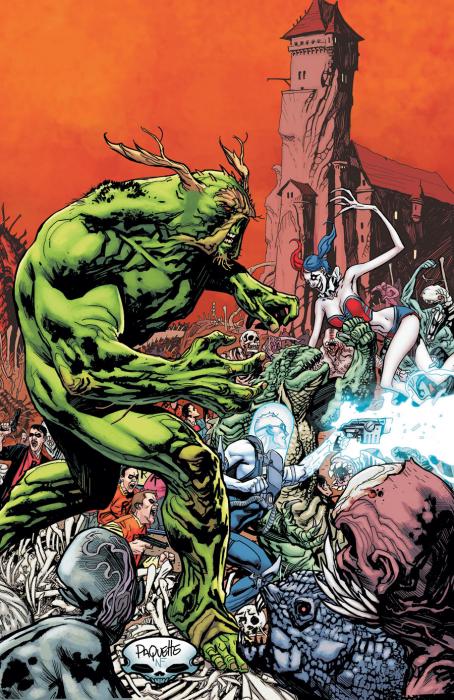
DM: Scott Snyder, on the other hand, in Swamp Thing #18 (DC), ties a bow on this story, and his run, in a manner that is satisfying and organic (pun intended–every time!). Amidst Yanick Paquette’s gorgeous leafmotif visuals is a story where the damsel becomes the hero, the demon is rent asunder, and our lovers have their stars well and truly crossed. But not before the creators generously allow them one last (first?) kiss, in which their passion literally burns. A fitting finale to a mostly excellent run.

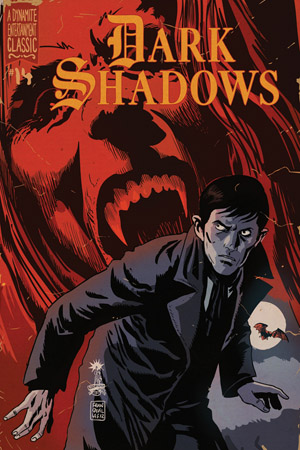
But Swamp Thing and Animal Man aren’t the only hero-inhabiting-a-new-body-travels-to-a-dystopian-future-to-defeat-unearthly-evil-then-returns-to-the-present-in-order-to-prevent-it-in-the-first-place stories this week. That’s right! The same exact plot is featured in Dynamite’s Dark Shadows #14!

Dark Shadows #14

Dark Shadows #14

Ah well, no new ideas and all that; it’s how well you handle them. Writer Mike Raight’s vampiric version involves Gothic plot twists, backstabbing (with wooden stakes, natch!) and enough Grand Guignol action to satiate any horror fan. Artist Nacho Tenorio does a nice job orchestrating the gore, alternating between excess and restraint, the way any 1960’s-influenced horror should. This isn’t all superficial bloodletting however. (SPOILERS!) Raight infuses some depth and existential quandary as the evil that the hero, Barnabas Collins, must destroy in order to save his family, is himself. There’s also a well-wrought, even delicate twist, as Barnabas’ mysterious ally reveals that aiding him and taking revenge upon him are, in this case, one and the same. Solid and compelling, this book is one of the most reliable sources of monthly macabre that you’re likely to find.

So, having been hooked by our attention-grabbing title, you’ve made it this far through our post, and yet you find yourself disappointed by the lack of any content that could be considered truly eye-opening.

SC: Hey!  What about my–

DM: Well then, you’ve got an idea of the experience of reading Sex #1 by Joe Casey and Piotr Kowalski (Image).

SC: Oh, I see.  Clever.

DM: Mr. Casey means well. In a heartfelt (and rather breathless) afterword, he holds forth on the state of today’s comics; mainly the continued dominance of the Big Two despite the wild variety and quality of other work out there. Well hear, hear! And yet, what does he offer us? A wealthy scion reluctantly returns to run his vaguely defined corporate empire. A seedy underworld controlled by a grotesque mob boss. Words of wisdom from a trusted Man (or in this case, Gal) Friday. And, oh yeah, said wealthy scion is a former superhero. This set up bears any number of resemblances to Batman, the newfangled Green Arrow, Ex Machina (a much better melange of superhero/real world tropes from eight years ago), etc. But wait, this has superheroes and sex. Well Watchmen broke that seal long ago. It’s simply no longer a shocking conceit (I mean even Catwoman’s done it for chrissakes). Now, to Casey’s credit, when the naughty section does occur, despite its fairly graphic nature, it’s contrasted in such a way that it is robbed of nearly all prurient titillation. The participants even call out the reader’s presumed lasciviousness, in a clever use of breaking the fourth wall. Kudos to Casey for subverting the expectations set up by his conspicuous title.  But in the end, this is just another superhero comic. And what’s so sexy about that?

SC: I hear ya.  Image did have another release this week that I enjoyed more than Sex—

DM: (tee-hee!)

SC: Uh-huh. Anyway, it’s Jim McCann and Janet Lee’s Lost Vegas #1.  It came with a little less hype than Casey’s book did, but it was loads better.  Though engaging from the get-go, McCann’s writing does prove a bit hard to swallow at times, especially as the Ocean’s Eleven-esque scheme is laid out; but Lee’s artwork is enviably voluptuous, a stunning exercise in sensuality.

DM: Yes, Lee’s work is certainly the star for me thus far. She blew me away on Return of the Dapper Men a few years ago (also written by McCann). There she dazzled with an unorthodox process that combined vibrant expressionistic backgrounds with the sublime precision of Winsor McCay (if you don’t know who that is, look him up. Look him up now.) Here the chameleon-like Ms. Lee seems to be offering something of the sensual loucheness of Aubrey Beardsley, combined with the sci-fi sensibilities of Richard Corben, and even a dash of Hayao Miyazaki for fun.

SC: That’s some company she’s keeping.

DM: Indeed. Like Batwoman, this could become a book that I buy for the art alone.

SC: Well worth the price of admission.  I’m certainly up for round two.

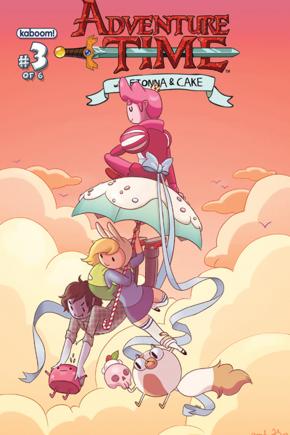
DM: Now, returning to our theme, for a nuanced, astute, refreshing exploration of sex, one need look no further than Adventure Time with Fionna & Cake #3 (kaboom!):

Adventure Time: Fiona and Cake #3

Adventure Time with Fiona & Cake #3

Sex, in this case, denoting gender. ‘A childrens’ book?’ you say, eyebrow ever so arched? Well in its brief existence, Pendleton Ward’s magical juggernaut has tackled such concepts as abandonment, existential loneliness, first loves, the bonds of honor and friendship, pride, sacrifice, betrayal, the origins of myth, the nature of evil, the afterlife, determinism, fate, and nuclear annihilation to name a few. It never addresses these issues head-on however (it’s much too smart for that), but from rather more of a sideways angle, (and perhaps, blindfolded). Y’know, Stuff Happens. Each candy-colored episode is wide open to (and the subject of) much interpretation. It’s the type of show that dissertations will be written about someday(if that hasn’t already happened). I ask you, what better place to consider gender and identity issues than the sociological phenomenon that is Adventure Time?

For those who don’t follow the show (losers!) Fionna and Cake was a fan-favorite episode which featured alternate, gender-swapped versions of series’ stars, Finn and Jake. Now Natasha Allegri, who had a hand in that episode, gives the ladies a chance to shine in their own title. Issue 3 is the best one yet. The first two issues established the characters as well the epic, yet tongue-in-cheek tone that AT does so well. The third issue really delves into the gender stuff and shows why this is not your father’s (um, older brother’s?) AT. The story begins with Marshall Lee (the male version of the vampire Marceline from AT) suddenly appearing in the lead characters’ home in a state of distress. But unlike his female counterpart, who is decidedly bad-ass, this vampire is positively sparkly. Needless to say, Fionna has a crush (-and Cake does not approve!) It seems they need to rescue Prince Gumball, who is caught in a ridiculous trap, which I won’t ruin for you. Nor shall I spoil all the loaded symbols, pregnant pauses and hysterical double entendres peppered throughout the tale. These never come across as forced or excessive; they are, indeed the story’s raison d’etre. I will say that they culminate in a visual gag so audacious that I couldn’t believe it was in a children’s comic, even as I barked with laughter. And yet it perfectly encapsulates the major theme of this series. Sound dirty? Well, again, it’s not because all of the above is not so much dealing with sex, as it is gender and identity. I am not suggesting (as I have with AT’s sister book Bravest Warriors) that this title is inappropriate for children. Part of Allegri’s brilliance (in addition to the beautiful art) is that this book is, on the literal level that children tend to read, an exuberant, imaginative adventure/fantasy. It certainly can (and should, to some degree) be enjoyed that way. The storytelling is deft enough that whatever other meaning children take away from it is entirely up to them. And you. Book of the Week.

Turning pages,

Derek & Scott

Share this:

  • Click to share on X (Opens in new window) X
  • Click to share on Facebook (Opens in new window) Facebook
  • Click to share on Tumblr (Opens in new window) Tumblr
  • Click to share on Reddit (Opens in new window) Reddit
  • Click to email a link to a friend (Opens in new window) Email
  • Click to share on Pinterest (Opens in new window) Pinterest
Like Loading...

I&Nterview: Escape Pod Comics

18 Monday Feb 2013

Posted by dmainhart in I&Nterview

≈ 1 Comment

Tags

Aardvarks Over UK, art, Austen, Cerebus, Comic shops, comics, Cynthia von Buhler, Dave Sims, Dickens, Downton Abbey, Escape Pod Comics, Hugo, Huntington, Huntington Arts Council, J.M. DeMatties, Lucy Knisley, Maus, Menachem Luchins, Page 45, Rocketship Comics, Sailor Twain, Sondheim

Escape Pod Comics, in Huntington, NY, provides an interesting take on the traditional comics shop. In fact, it’s owner, Menachem Luchins, proclaims it “the future of comic book stores.” We took some time to ask Menachem about his vision:

Derek Mainhart: So, Menachem, what’s the concept behind Escape Pod Comics?

Menachem Luchins: The concept behind Escape Pod is that there is a comic for everyone. Despite the fact that comics are becoming more and more popular, people still see them as a niche medium. They think all comics are super-heroes, or at least fantastical. While that may be a small majority of the books there really is something for every taste and age group.

More than just believing in this, we want the FEEL of Escape Pod to reflect it. That’s why if you walk in to our shop you’ll see books by genre, a HUGE kid’s section, chairs and table for reading and a whole slew of discounted used books. We want you to browse, to be comfortable. We also want to educate and investigate, which is why we’ll be offering classes and events on how comics work.

DM: Where did the idea for this kind of store come from? Give us some background info.

ML: Well, for a few years I used to travel from upstate NY to Brooklyn just so I could shop at Rocketship Comics on Smith Street. When they closed I actually cried. I also bought out a lot of their stock and fixtures, including a spinner rack of my own. I used to joke about opening my own store with all the stuff I bought from them. A year later, I was re-reading Dave Sim’s Cerebus but this time with all the letters, articles, etc and came across Mark Simpson and Stephen Holland’s manifesto for their store Page 45, which they created after putting together the Aardvarks Over UK tour for Dave and Gerhard and something just clicked… Here I was, commuting to a teaching job that I was just too burnt out to enjoy and these guys were talking about selling comics to EVERYONE. A year later I went for it and here we are.

DM: Ah yes, I know the pain of losing a beloved store. Which brings me to another question: You’re opening up a comics store?! In this economy?! Are you crazy?!!!

ML: Well, the simplistic answer is that I’m not looking to strike it rich or even make “a lot” of money, I’m just planning on making enough to get by (with a wife and three kids…). I’ve never really been a very money-centric guy. If I was, I could tell you how comics are the only print medium that actually had INCREASED sales in the last year, how people buy entertainment and escapist works MORE in a recession. I would point out that thanks to the economy, a 90-minute movie costs about what a 200+ page comic costs and that a paperback novel is closing in on that price-point as well. I could also, getting off the money issue, go on and on about smart buying as a store and how our cultural events, classes and signings are going to make us much more than just a shop, but a community center. All of that is an explanation but none of it is really the answer. The real answer, honestly, is a combination of all those things and many more. But to more directly and succinctly answer your question: Yes, I’m crazy.

DM: Heh. Tell us a little bit about the classes you’re offering.

ML: Funny you should ask… We’ve got the incomparable Derek Mainhart lined up to do some classes.

DM: That guy’s a hack.

ML: My current plan for that is to give Derek the store space every Saturday. Space will be cleared and he will be free to teach however many classes he wants, or bring in other people to teach at the same time or at different times, whichever. We don’t have a firm date on this, but we’re looking at the summer.

Until then I’m going to be calling in some chips: the legendary comic writer J.M. DeMatties has already agreed to give a lecture or class one day.  So has Lucy Knisley. Cynthia von Buhler, who is kind of my patron saint, has agreed to come down for something, and to sell some of her comic’s original art through us.

Just today, a gentleman who wandered in, insisting he didn’t read comic books but was wondering if I sold “illustrated novels, like Maus,” suggested that I teach a literature class for adults once a month. When people wander in off the street I like to give them my full attention; since the store doesn’t really need anything immediately, I’m able to explain my plans and goal better and just chat.

Chatting with this guy and his wife led us all over: from Downton Abbey to Hugo to Dickens to Austen to Sondheim… After which, he made that suggestion. I insisted that it would have to be a comic class, but could easily be a literary one. He was all for it, was ready to sign up then and there. His wife too. Hmmm… Sailor Twain, maybe?

DM: Sounds like an impressive lineup (other than that Mainhart guy). You also mentioned hosting “cultural events.”  What sorts of things do you have in mind? Anything in the works?

ML: Well, I’m currently working with the Huntington Arts Council on their exciting Spark Boom program, which is starting in spring and running until the end of the summer. There are going to be all sorts of events at various locales and stores in the area and we may even be hosting a few in the store.

Aside from that, I’m talking to some artists (none very firm yet) about doing small shows in our space. There are also lectures planned to educate the average person on what exactly comics are. After all, they’re not just for kids anymore…

DM: Amen to that! So, education, lectures, art exhibits: sounds like you really want to be part of the local community. To paraphrase Homer (Simpson): Is there anything Escape Pod Comics can’t do?

ML: Well, we won’t be selling toys or t-shirts… So there’s that. Frankly, a good book store, whether it’s solely devoted to just comics or to the written word or both, SHOULD be all those things. In recent years the Internet and franchises have destroyed the literally thousands of stores that used to exist like this all across the USA. Our goal is to bring the comfort of a joyous shopping experience at a place that knows you, your town and your interests, back. But I guess you’ll have to stop in to the store to see if we’ve been successful.

Escape Pod Comics. Check it out.

Share this:

  • Click to share on X (Opens in new window) X
  • Click to share on Facebook (Opens in new window) Facebook
  • Click to share on Tumblr (Opens in new window) Tumblr
  • Click to share on Reddit (Opens in new window) Reddit
  • Click to email a link to a friend (Opens in new window) Email
  • Click to share on Pinterest (Opens in new window) Pinterest
Like Loading...

Back and Forth: Red, Green & Blue

16 Saturday Feb 2013

Posted by dmainhart in Back and Forth

≈ 1 Comment

Tags

Alberto Ponticelli, American Vampire, Andrea Sorrentino, Animal Man, Brian Bolland, China Mieville, Dan Green, DC Comics, Dial H, Essex County, Green Arrow, Jar Jar Binks, Jeff Lemire, New 52, Rotworld, Sarah Connor, Scott Snyder, Severed, Swamp Thing, Sweet Tooth, Terminator

Scott Carney: While never done in a ceremonial manner–certainly never hand to heart–I think it’s safe to say, as evidenced by my weekly What’s Up? posts, that I have publicly pledged allegiance–in a case or two, unabashedly blind allegiance–to an exclusive club of comic creators.  Two fellas who fall into that illustrious legion of superscribes are Scott Snyder (Severed, American Vampire) and Jeff Lemire (Essex County, Sweet Tooth).

But I fear–as I do fondly while reading the best of Snyder–that I no longer hear the deliciously shuddersome voice that drew me to him in the first place.  Certainly not in Swamp Thing #17.

Swamp Thing #17

Swamp Thing #17

And, I no longer hear Lemire’s refreshingly veracious voice, either, if I’m being honest–as heartwrenchingly honest as he is when he’s at his best.  Certainly not in Animal Man #17.

Animal Man #17

Animal Man #17

It seems, here, in the two-book Rotworld finale, that each–a true master of his craft–has been thwarted by a wholly unexpected villain: the run-of-the-mill comic book hero.  (Don’t get me wrong: on both fronts, the build up to the finale was just fine.  If I’m being fair, however, Snyder’s work on Swamp Thing was more effective than Lemire’s on Animal Man–most assuredly because Snyder was living closer to home: the terrifying creatures littering the landscape of Rotworld are natural notes for him to play; and he played them well enough–again, until the end of this corrosive crossover.)  What irony, eh?  After laying a foundation–spanning several solid issues– upon which the defenders of fauna and flora fight alongside a surviving set of superbeings, what happens to Snyder’s signature horror?  It’s foiled by the hero.  What happens to Lemire’s signature honesty?  It, too, is foiled by the hero.  Foiled by the heroes’ hailstorm of shockingly silly lines–one more horrifically ridiculous than the next.  Foiled by the heroes’ lack of believable layers, leaving them flat and cold, leaving them decidedly devoid of emotion; leaving them an unbridgeable distance from the ones they supposedly love–and from us.

So, as each creative team shoves its protagonist closer to the end–in this case, toward a portal to the past, which will allow the pair “to stop Arcane” from establishing Rotworld in the first place, kind of like a couple of Terminators after Sarah Connor–the cracks widen, deepen; and the finale collapses under the weight of the concept, resulting not in the presumably successful symphony for which we paid admission, but, instead, in a cacophony of defeat.

Derek Mainhart: I have to agree. What was so interesting about these two titles was  each writer applying their own distinctive voice to the superhero trappings;  Snyder’s almost clinical way with horror and Lemire’s naturalistic rendition of family dynamic amidst trying times. That they were able to do this while simultaneously working different sides of the same story was even more impressive. Now though, both of those strengths have been subsumed by the perceived requirements of epic storytelling: wooden dialogue, numbingly explosive action, and awful sidekicks (in particular, the character of Shepherd suggests Lemire is a part of that small, but distinctive demographic: the Jar Jar Binks fan). Yes, Animal Man has fared worse. As you say, Rotworld is more in Snyder’s wheelhouse; in fact, as I’ve said, the previous issue of Swamp Thing was quite good. And so, despite the unholy mess that was these two issues, I still have (some) faith that Snyder might be able to tie this all up with some sort of fitting coda, in what will be, after all, his last issue. Now that our heroes our back in the present, I hope that Lemire, who is continuing on Animal Man, will return to his strengths as well, tripping the light fantastic between the everyday and the extraordinary. Because the overweening superhero stuff is simply not him.

To wit: Green Arrow #17. This was billed as “jumping on point” due to the new creative team of Lemire and Andrea Sorrentino. And it delivers, in a ‘by the book’ (‘buy the book’?) sort of way: the hero’s status quo is violently dismantled by a new villain who seems to know everything about him. A new mystery is introduced regarding said hero’s past. Confidantes are killed, and cryptic utterances, uttered. All the notes are hit. And yet, to continue your musical metaphor, it doesn’t sing. It’s like a robot playing Beethoven; a rote exercise. Now I’m obviously not a regular reader of Green Arrow. Perhaps to fans of the emerald archer, this issue provided a new direction, a sense of excitement. But I picked it up because it was a Jeff Lemire book. Sadly there is nothing of his voice in this. Anyone could’ve written it.

SC: I hear you, sir! If anything, it’s a three chord ditty: it’s listenable, sure–likeable, even, for what it is; but in the end, what is it, really?  One thing’s for sure, it’s not what we love from Lemire.

DM: What we love, indeed. But what’s all this talk of “voice” and “music”?  In a superhero comic? We’re expecting too much you say? Shame on you, you should know better by now. Any genre can achieve stirring crescendo given the right creator.

I submit: Dial H #9. This issue, indeed the entire series, has served up an aria of imagination by writer China Mieville. His unending cavalcade of absurd, sublime heroes is itself worth the price of admission–not to mention this ridiculous cover by Brian Bolland:

Here, we are treated to the monstrous Minotaura, and her singular method of ensnaring her prey.  (Kudos also to artists Alberto Ponticelli and Dan Green who are quickly finding their feet on this title.)  And then there is The Glimpse, a hero whose inspired power is to stay forever at the periphery of your vision. You see a glove here, a boot there, but the hero himself is just beyond your reach, always teasing you with his promise, but ultimately leaving the panel empty. If there’s a better metaphor for the never-ending, epic-obsessed, hype machine that is the current state of the superhero industry, I’ve yet to find it.  Want to say it together?

SC: Sure! Yeah!  Let’s harmonize. Ready, on three.  One…Two…

SC & DM: Book of the week!

Turning pages,

Scott & Derek

Share this:

  • Click to share on X (Opens in new window) X
  • Click to share on Facebook (Opens in new window) Facebook
  • Click to share on Tumblr (Opens in new window) Tumblr
  • Click to share on Reddit (Opens in new window) Reddit
  • Click to email a link to a friend (Opens in new window) Email
  • Click to share on Pinterest (Opens in new window) Pinterest
Like Loading...

Top 5 Comics – Jan 2013

06 Wednesday Feb 2013

Posted by dmainhart in 5 Comics You Should Be Reading

≈ 1 Comment

Tags

Abstract Studio, Alfred Hitchcock, Bravest Warriors, Dan Slott, Dark Horse, Ed Brubaker, Fatale, Fury: My War Gone By, Garth Ennis, Goran Parlov, H.P. Lovecraft, Image, Joey Comeau, kaboom!, Marvel Max, Marvel NOW!, Matt Kindt, Mike Holmes, Mind MGMT, Rachel Rising, Ryan Pequin, Ryan Stegman, Sean Phillips, Superior Spider-Man, Terry Moore

Preeeesenting the Top Five Comics of the new year! Top Five according to what criteria you may ask? Sales? Nope. Democratic process? Hell no! Blindfolded monkey? Interesting! Maybe in the future.  But for now these are simply the books that tickled our fancy the most in the past 31 days. And while our reading list is impressive, it is by no means exhaustive. in other words, these are the Purely Subjective Favorites of the Books We Happened to Read. But Top 5 sounds better!

In reverse order, ’cause countdowns are fun:

5. Bravest Warriors #4 (kaboom!) – Our heroes get humiliated, decapitated and degraded, as their lifeless skulls are used to put on a puppet show. And that’s just the first five pages! Joey Comeau and Mike Holmes continue to dole out the delightful depravity. And the back up feature by Ryan Pequin: oh, what have you done to our most beloved Founding Father? I’ve said it before and i’ll say it again: despite its trappings, this comic ain’t for kids. But it is most certainly for me. (DM)

4. Fury My War Gone By #8 (Marvel) – Garth Ennis has struck gold with this series–our No. 9 book of 2012; and with #8, he digs even deeper and strikes, well, golder with a violent chorus of well-tuned voices and a series of choices that burns hotter than napalm. (SC)

3. Rachel Rising #13 (Abstract Studio) – Terry Moore’s charnel epic heats up as revenge most heinous is set in motion, even as the narrative takes a time-out for a fairy tale. Suspense, dark humor and semi-dead vixens in beautiful black and white. This comic is so cool it burns. (DM)

2. Mind MGMT #7 (Dark Horse) – Who’s doing more between the covers than Matt Kindt?  He’s a one-man creation crew with clear vision and the enviable ability to convey it–and all its wondrous complexity–with scintillating precision.  And he knows he’s good, too: at the end of this issue, through Henry Lyme, who makes a promise to Meru, Kindt makes a solemn promise to his readers, me and you: “You’re going to get a hell of a good story.”  I’d expect nothing less!  That’s right, folks: our #3 book of 2012 is already staking its claim for the top spot of 2013. (SC)

1. Fatale #11 (Image) – No surprise that our No. 5 book of 2012 leapfrogs to the top spot this month. Ed Brubaker has been putting on a clinic of genre writing with this series, from 50’s noir to 70’s sleaze, and all with an undercurrent of Lovecraftian dread. This issue gives a nod to the pulp origins of our favorite medium, presenting a tale-within-a-tale involving occult shenanigans in the Old West. And what the hell? Frame it in Hitchcockian suspense for good measure. Sean Phillips has proven adept at keeping the tone deadly steady with his art, no matter what Brubaker throws at him. This one’s firing on all cylinders folks. Time to hop on board. (DM)

The Biggest Dis(appointment): Superior Spider-Man #2 (Marvel) – Give up the ghost, already.

So that’s our list folks! What’s yours?

Scott & Derek

Share this:

  • Click to share on X (Opens in new window) X
  • Click to share on Facebook (Opens in new window) Facebook
  • Click to share on Tumblr (Opens in new window) Tumblr
  • Click to share on Reddit (Opens in new window) Reddit
  • Click to email a link to a friend (Opens in new window) Email
  • Click to share on Pinterest (Opens in new window) Pinterest
Like Loading...
← Older posts
Newer posts →

The Nerds

  • dmainhart's avatar dmainhart
  • ScottNerd's avatar ScottNerd

Enter your email address to follow this blog and receive notifications of new posts by email.

Join 142 other subscribers

An Amazing Comic Shop

Wiggle Room

It's just the beginning...

Tag Salad!

Ales Kot All-New X-Men Animal Man Archer & Armstrong Avatar Batman Batwoman Bloodshot BOOM! Brian Azzarello Brian K. Vaughan Brian Michael Bendis Brian Wood China Mieville Chris Bachalo Chris Samnee Clone comics Cullen Bunn Daredevil Dark Horse DC DC Comics Dial H Dynamite Dynamite Entertainment Ed Brubaker Fatale Fiona Staples Fred Van Lente Garth Ennis Goran Parlov Grant Morrison Greg Rucka Harbinger IDW Image Image Comics J.H. Williams III J. Michael Straczynski Jason Aaron Jeff Lemire Jonathan Hickman Jordie Bellaire Joshua Dysart Kevin Eastman Kieron Gillen Kurt Busiek Lazarus Mark Waid Marvel Matt Fraction Matt Kindt Mike Allred Mind MGMT Nick Spencer Oni Press Rachel Rising Robert Venditti Saga Scott Snyder Sean Phillips Swamp Thing Teenage Mutant Ninja Turtles Terry Moore The Massive Titan Uber Ultimate Spider-Man Uncanny X-Men Valiant Vertigo Wonder Woman X-O Manowar zero

Archives

  • August 2022
  • March 2022
  • February 2022
  • December 2021
  • August 2020
  • November 2018
  • October 2018
  • September 2018
  • August 2018
  • July 2018
  • August 2017
  • September 2016
  • August 2016
  • July 2016
  • September 2015
  • August 2015
  • July 2015
  • June 2015
  • May 2015
  • April 2015
  • March 2015
  • February 2015
  • January 2015
  • December 2014
  • November 2014
  • October 2014
  • September 2014
  • August 2014
  • July 2014
  • June 2014
  • May 2014
  • April 2014
  • March 2014
  • February 2014
  • January 2014
  • December 2013
  • November 2013
  • October 2013
  • September 2013
  • August 2013
  • July 2013
  • June 2013
  • May 2013
  • April 2013
  • March 2013
  • February 2013
  • January 2013
  • December 2012
  • November 2012
  • October 2012
  • September 2012
  • August 2012

Features

  • 22 I&N 22
  • 5 Comics You Should Be Reading
  • Back and Forth
  • Derekommendations
  • I&N Print
  • I&N Review
  • I&N Scott's Bag
  • I&N Store
  • I&N the Gutter…
  • I&N's Top Ten
  • I&Nsight
  • I&Nterview
  • Innie Awards
  • Microviews
  • Scottlight on…
  • Superhero Friday!
  • Top 5 Books of the Month
  • Uncategorized
  • What's I&N Store?

Recent Posts

  • Creator Watch: Deniz Camp
  • The Best Comics You’re Not Reading
  • Pick of the Week
  • Best Comics of 2021
  • Worth Your Time

Real Nerdy Stuff

  • Create account
  • Log in
  • Entries feed
  • Comments feed
  • WordPress.com

Twitter Updates

Tweets by imagesandnerds

Top 3 Posts & Pages

  • Creator Watch: Deniz Camp
  • The Best Comics You're Not Reading
  • Pick of the Week

Finders Keepers

Create a free website or blog at WordPress.com.

Privacy & Cookies: This site uses cookies. By continuing to use this website, you agree to their use.
To find out more, including how to control cookies, see here: Cookie Policy
  • Subscribe Subscribed
    • Images and Nerds
    • Join 57 other subscribers
    • Already have a WordPress.com account? Log in now.
    • Images and Nerds
    • Subscribe Subscribed
    • Sign up
    • Log in
    • Report this content
    • View site in Reader
    • Manage subscriptions
    • Collapse this bar
 

Loading Comments...
 

    %d