• The Big Picture
  • Here’s ScottNerd…
  • Here’s DerekNerd…

Images and Nerds

~ We're turning pages–and writing about them!

Images and Nerds

Tag Archives: Silver Age

Top 5 Books of April

29 Thursday May 2014

Posted by ScottNerd in Top 5 Books of the Month, Uncategorized

≈ 8 Comments

Tags

Astro City, Brent Eric Anderson, Brian Wood, Dan Slott, Daniel Zezelj, Dark Horse, DC, Douglas Adams, Dr. Strange, Elmore Leonard, Garth Ennis, Goran Parlov, Greg Rucka, Image, Innie Awards, Jack Kirby, Jason Aaron, Jason Latour, Jordie Bellaire, Justified, Kurt Busiek, Laura Allred, Lazarus, Mark Millar, Marvel, Michael Lark, Mike Allred, Moby Dick, Roy Thomas, Silver Age, Silver Surfer, Southern Bastards, Stan Lee, Steve Ditko, T.H. White, Terry Pratchett, The Massive, The Once and Future King, Vertigo, Watchmen

#5. Astro City #11 (DC/Vertigo): A quick perusal of our past Top 5 lists will tell you that we’re generally not the biggest fans of superhero fare. Oh sure, we have a soft spot in our hearts for the cape and costume set; they were after all our gateway drug into the wider world of comics. But with such a bevy of quality non-superhero books inhabiting the current comics landscape (it really is a golden age folks), why waste our time on the cynical merry-go-round of movie tie-ins, Big Events and the never-ending, never-changing battle? Even worse are those titles which claim to be edgy by adding some nominally ‘mature’ wrinkle to the works: ‘superheroes who swear!’ ‘superheroes who have sex! (full frontal!)’ or some other such trope that was well-worn by Watchmen nearly thirty years ago. It takes something far less gimmicky to add something new to the genre (and that’s what superheroes are, fanboys; not mainstream but a genre).

Luckily, in Astro City, Kurt Busiek and Brent Eric Anderson have managed just that. Nearly a year into the title’s return after an extended hiatus, Busiek and Co. remind us of their mastery of the eye-level approach to the fantastic. This time out centers around a personal assistant, the type of capable multi-tasker who’s invisible to the public and indispensable to her boss. But of course in this case, her boss is a superhero. Like many in her profession, her duties include, but are not limited to: answering mail, keeping track of finances, scheduling appointments, etc. But because her boss is a mystical Dr. Strange type, a missed appointment can mean placating interdimensional gods who threaten our world with annihilation for their inconvenience. The story is an ode to all of the unsung, behind-the-scenes supporting players who, through sheer competence, organization and the ability to keep a cool head, keep the world running, day in, day out. The pleasure comes from watching our harried-but-never-overwhelmed protagonist put out fires, ranging from the mundane to the apocalyptic, with nothing more than a well-placed phone call or a sift through her files. That, and the loving, sideways homage Busiek and Anderson have crafted to some of the stranger Silver Age forays of Kirby, Ditko, Lee, Thomas, et al. To paraphrase, there are a million stories in Astro City. This is one of the best. (DM)

Astro City #11

Astro City #11

#4. Silver Surfer #2 (Marvel): What goes on here? Two superhero books from the Big Two crack our Top 5? Well yes, when one of them is drawn by the inimitable Mike Allred. His wild, Pop Art aesthetic (enhanced by the bold hues of wife Laura Allred) immediately brings the fun to any book it graces. And Dan Slott scripts a tale to match involving intergalactic hucksters (‘the Incredulous Zed’) extra-dimensional god-constructs (‘The Queen of Nevers’) and sensitive Plorpian digestive systems. Not to mention the true protagonist of the story, one ‘Dawn Greenwood’ of Anchor Bay, Massachusetts. Appropriately titled “Everything And All At Once”, the story owes less to typically constrictive superhero dynamics, and more to the expansive exuberance of the likes of Douglas Adams and Terry Pratchett (despite our American creators, there is  something distinctly British about the proceedings; a compliment, naturally.) In other words, if you’re looking for a rollicking good sci-fi bender of a time (and why wouldn’t you be?), you could do a lot worse than Silver Surfer. (DM)

Silver Surfer #2

Silver Surfer #2

#3. Lazarus #8 (Image): Greg Rucka and Michael Lark are on quite a run: this is the third month in a row that we’re celebrating Lazarus as a top book.  (It’s true: check out what we had to say about the patient perfection of #6 and #7!)  What’s keeping the book pegged to the big board issue after issue?  It’s the storytelling.  The fellas have forged themselves a winning formula–one that’s made all the more impressive by the fact that in no way does it feel like they’re going through the motions; no, they’re keeping it fresh as can be, once again to purpose employing parallelism to amplify further the conflict, which has been an eager flame burning its way through a long fuse to an explosive effect without any bombs going off–at least not quite yet, anyway.  This installment of the 2014 Innie nominee for Best Ongoing Series is once again built upon a foundation of the early days of Forever.  In this case, Forever fails to live up to expectations and misses out on a meeting–on her birthday, no less!–with her frustrated father, who leaves a very significant gift behind: White’s The Once and Future King, an insinuation that speaks to Forever’s growth and purpose–and, in that, to Rucka’s inspiration for the series.  This significant sequence comes back around when present Forever finds herself in an ethical bind, knot courtesy of a catty Daddy Carlyle, over the impending terrorist attack in Denver.  Oh, the road to Denver is paved with good intentions, innit?   Doing most of the paving: Michael Barret and Casey, who, while on their way to the Lift Selection, are willing to offer up a hand to their fellow travelers, including, at the very end, an Angel of Death.  It’s all coming to a head, folks; and the book–and we–couldn’t be in better hands. (SC)

Lazarus #8

Lazarus #8

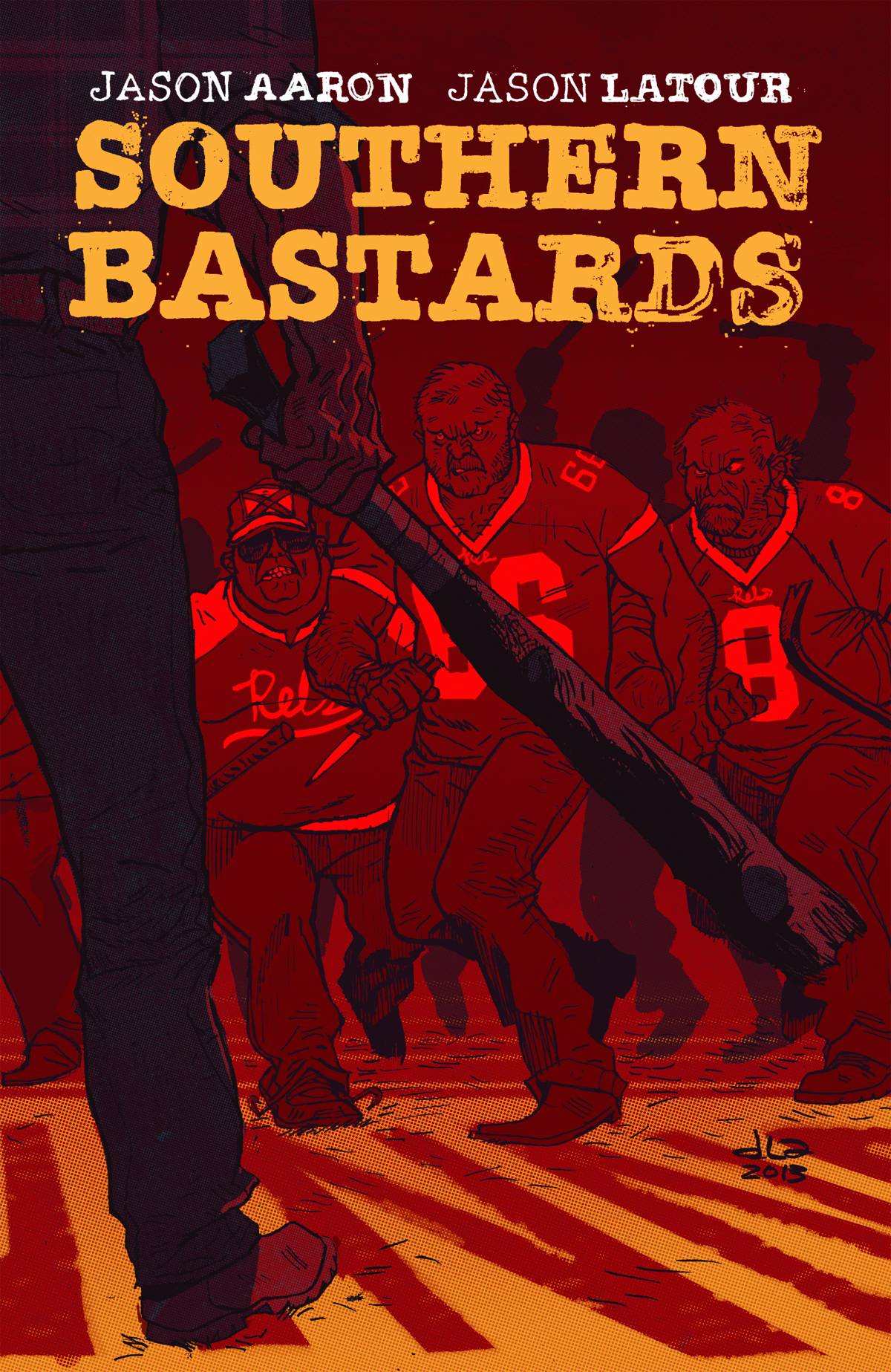
#2. Southern Bastards #1 (Image): Oh.  Shit.  Jason Aaron and Jason Latour have made quite a splash with their merciless ode to good ol’ boys.  Now, I’m predisposed to liking it because of its being not unlike Justified, with its Southern-fried setting and tone, and even its well-defined yet ambiguous cast of characters, smacking of the late, great Elmore Leonard, and, in that, the often late, great Garth Ennis–which makes even more sense considering that it also reads a hell of a lot like Fury: My War Gone By and Mark Millar’s Starlight because of the big notes of nostalgia and, tying it all together, because Latour’s Earl is plenty Parlovian.  The story’s solid from the get-go: Jason Squared pitches the prodigal son’s return and expertly upsells pathos as the conflict grows–just as a tree grows from Earl’s father’s grave–into the final sequence, itself a grueling duel of duels–a one-two combination (punishing blows received and delivered) of violent events enlivened by the lyrical layouts–that cements this debut as a top book of the month; it’s the love shown by the creators for the South and the story inspired by it that makes it even more than that.  (SC)
Southern Bastards #1

Southern Bastards #1

#1. The Massive #22 (Dark Horse): Thus far, Brian Wood’s apocalyptic take on Moby Dick has focused on one Callum Israel, whose Ahab-like obsession with finding his eponymous ship has led him to the far corners of a world that is slowly falling apart due to a mysterious event known as The Crash. The search has allowed Wood to explore in convincing detail (with the help of an impressive cadre of artists; here Danijel Zezelj does the honors, with Jordie Bellaire on colors) the effects of environmental devastation, economic collapse, and political disintegration in such disparate locales as Iceland, Hong Kong and Mogadishu. The sheer breadth of Wood’s geopolitical knowledge and inquiry is impressive. It also pulls off the neat trick of serving as both the series’ raison d’etre and narrative backdrop to its central mysteries: Where is the Massive? What caused The Crash?

Just as the answers have eluded the increasingly obsessive Callum (did I mention he was dying of cancer?), Wood’s writing has sometimes been frustratingly vague. Many of the arcs (all consisting of three issues) have run like this: fascinating set-up, high stakes climax, baffling denouement. While there’s something to be said for not giving the reader what they want, the considerable tension inherent in the story has sometimes been undercut by endings that seem deliberately anticlimactic, and even obtuse. Well the first issue of the latest arc, “Sahara”, finally promises some resolution, beginning with the one to the other great mystery: Where the hell has Mary been?

Mary, Callum’s lover, shipmate, and conscience of his crew, seemingly abandoned him in his time of greatest need. This issue finds her, in typical Wood fashion, smack dab in the middle of a geopolitical intrigue with real-world resonance. She’s guarding a convoy of the world’s most precious post-Crash resource: water. As the spotlight shifts to her, we begin to realize what Wood has been hinting at all along: the search for the Massive is a MacGuffin. All mysteries lead to Mary. By turns the most compassionate and the most remote, she has quietly taken on an otherworldly dimension. As we watch Mary cross the desert, now with child, one cannot help but think that as the series builds to its conclusion, Wood is countering the obsession and despair of the white whale with an almost biblical hope for salvation. (DM)

The Massive #22

The Biggest Dis(appointment): Mind MGMT #21 (Dark Horse): To truly understand this choice, you have to understand that disappointment comes from expectations not being met–and in some cases, from expectations being bitch slapped by promises unfulfilled.  In this case, we were led to believe that master storyteller Matt Kindt was going to deliver a “silent issue”; and if you we’re like me, you thought immediately to the silent issue of all silent issues: G.I. Joe #21 from Larry Hama and Steve Leialoha, which blew our minds thirty years ago–yikes!  With the poison–the potent neurotoxin nostalgia–already in the wound, what chance did this stab at a silent issue have–especially after our being rudely welcomed by word one!  Wouldn’t you know: Kindt–ever the clever creator–was playing us from the promise!  His interpretation of silent: no dialogue–which means that thoughts are fair game; and to make the game more fun, those thoughts were insightful, sure, but sometimes ironic, considering the situations in which the thoughts were, umm, thought.  So, fine, it’s “silent,” I’ll buy it–and I did buy it, blissfully ignorant and high on hope; however, while the story works well within the world of Mind MGMT, Kindt has managed to both exploit and execute my innocent expectations.  The former finds me somewhat satisfied, but it’s the latter than leaves me mostly nonplussed–and this issue as our Biggest Dis(appointment) of the month.  (SC)

Mind MGMT #21

Mind MGMT #21

Turning pages,

Scott & Derek

Share this:

  • Click to share on X (Opens in new window) X
  • Click to share on Facebook (Opens in new window) Facebook
  • Click to share on Tumblr (Opens in new window) Tumblr
  • Click to share on Reddit (Opens in new window) Reddit
  • Click to email a link to a friend (Opens in new window) Email
  • Click to share on Pinterest (Opens in new window) Pinterest
Like Loading...

Top 5 Books of March

21 Monday Apr 2014

Posted by ScottNerd in Top 5 Books of the Month

≈ 8 Comments

Tags

Afterlife With Archie, Archie Comics, Brian Wood, Carmine Infantino, Dan Slott, Dark Horse, David Lapham, El Capitan, Epic, FF, Francesco Francavilla, Frank Miller, Garry Brown, Great Lakes Avengers, Greg Rucka, Image, Jack Kirby, Laura Allred, Lazarus, Madman, Marvel, Matt Fraction, Michael Lark, Mike Allred, Moebius, Parable, Pulp Fiction, Quentin Tarantino, Ren & Stimpy, Robert Altman, Roberto Aguirre Sacasa, Silver Age, Silver Surfer, Sin City, Stan Lee, Stray Bullets, Stray Bullets: Killers, The Flash, The Massive

#5. Silver Surfer #1 (Marvel): I’ve said it before and I’ll say it again: Mike Allred brings out the best in his writers. For most of his existence, the Silver Surfer has been a solemn, portentous presence in the Marvel universe. To be fair, this was written into Stan Lee and Jack Kirby’s very concept of the character: he’s the herald of Galactus, destroyer of worlds, after all. If the Surfer showed up, your goose was cooked. Of course, in the end he sacrificed his freedom, not once but twice in order to avert disaster. The tragic nature of the character has been explored by writers ever since, from Steve Englehart to Jim Starlin and perhaps best exemplified in Stan Lee’s Epic return to the character in Parable (drawn with graceful panache by the legendary french artist Moebius). All well and good, but somehow left unexplored in all of this was what was originally suggested by Kirby’s truly rad character design: a genius amalgam of surf culture and space age sleekness (this was the ’60’s after all). Outside of Carmine Infantino’s design for The Flash, the look of the Surfer is simply the coolest representation of that bold, optimistic era. Space Opera meets Pop Art. A gnarly rider of the cosmic waves, he puts the Silver in Silver Age. So why’s he such a bummer all the time? Where’s the fun?

Enter Mike Allred. As many (but not enough) comics fans know, Allred’s seminal Madman was almost single-handedly putting the fun back in superhero comics back in the 1990’s. In an era defined by, dank, “gritty” violence (which somehow purported to be more “mature”) Madman harkened back to a time of limitless, zany possibility. That an “independent” comic had to remind the Big Two how it was done was sad commentary on comics of the era. Now, twenty years later, and “mainstream” (whatever that means) superheroes are finally catching up. And at Marvel, Allred is finding a fertile ground to play in. On the recently concluded FF, writer Matt Fraction wisely amped up the absurdity to take advantage of his artist’s manic sensibility. The result was one of Marvel’s most entertaining books in recent years. Call it the “Allred Effect” (please do, I’m accepting royalties).

Now, with writer Dan Slott, he’s taking on one of the big guns. And if the first issue’s any indication, we’re in for a grand ol’ time. Slott, no stranger to strangeness, what with his runs on Great Lakes Avengers and Ren & Stimpy, again wisely plays to his artist’s strengths, setting the story on a fantastical casino/resort/amusement park the size of a planet (seriously, dig the double-page spread). Slott stays true to the character however; indeed the comedy arises out of the contrast between the ever-serious Surfer and his increasingly ridiculous surroundings. In a similar vein, Slott highlights the bizarre bazaar even further by cleverly juxtaposing it with the quotidian goings-on at the quaintest little New England bed and breakfast you ever saw. And all of it rendered by Allred (with beautiful colors by his wife Laura) whose wild and wooly aesthetic, brimming with possibility, is the guiding principle for the book. This promises to be fun. (DM)

Silver Surfer 001 Mike Allred Cover

Silver Surfer #1

#4. The Massive #21 (Dark Horse): Oh, we’ve been waiting for this!  Boys and girls, Brian Wood has done it!  The patient poet, who tells a mighty fine tale in a most measured meter, has finally followed a spectacular second stanza–the most recent celebrated just last month in this very blog–with a worthy third that doesn’t simply satisfy–it electrifies!  Wood, ever the simmering salesman, at last has boiled over, has pulled the trigger at precisely the right moment, ending the arc by ending Arkady and, perhaps more significantly, the malignant matter of trust between the cancer-ridden Callum and his loyal Ninth Wave mate, Mag.  And, as a bookended bonus, Wood, with a little Bay City backstory at the beginning, teases even more about Mary, and, at the end, marries her mystery to that of The Massive and the Crash.  Garry Brown, busy now with Marvel’s Iron Patriot, delivers some of his best work on the series, evidenced emphatically by a final splash that reveals exactly what’s on Callum’s mind: the song that cinches it–that links the lady in question to the last day of the world as they knew it–and this last issue of The Massive as we know it.  That’s right: expectations have officially been rejiggered: Wood and Brown aren’t all slow boil, after all; if they need to, it’s quite clear: they can scald.  Can’t wait to see how this mystery, one of the more intriguing in comics today, plays out in the next arc: Sahara.  I can already feel the heat! (SC)

The Massive #21

#3. Lazarus #7 (Image): Looking for a lift?  Ain’t gonna find it here; I mean, just look at the cover:

Lazarus #7

Instead, Greg Rucka and Michael Lark segue smoothly into the next sequence of steps in the well-choreographed comparison between Forever Carlyle and Casey Solomon, joylessly juxtaposing the incomparable plights of Family and Waste.  The opening scene, paced patiently in order to deliver an emotional punch, is a trying training exercise that exposes the fledgling Forever’s fragility.  During the revealing conversation between Forever and her mentor, Marisol, Lark plays angles and eyes to perfection, amplifying the pain of innocence lost–of growing up Forever.  Casey, on the other hand, doesn’t have the luxury of training; she must master the moment when it arises–and in the “Badlands,” a moment “Kraks” the night and cruelly cuts down young Leigh, which leads to Casey’s first two “Kraks” at doing what needs be done–and she is masterful.  Yes, the storylines are solid: the terrorist threat still exists, and present-day Forever and Johanna work toward breaking Emma, the one suspect they have in custody, by offering to lift her from Waste to Serf; and the Barrets, whose hopes for the future have been slashed by a third, still have their sights set on Denver, which is where the all-important–and apparently well-attended–Lift Selection will take place.  But what makes this issue one of our selections is the impeccably employed parallelism, which brings a curious parity to a world where there seemingly is none. (SC)

#2. Afterlife With Archie #4 (Archie): “Please don’t…Don’t make me do this,” indeed. I’m crying right now. Crying!  All I did was open the damn book to refresh myself—you know, in order to piece together a proper review—and then “Ker-rasshhh!!!” I mean, I can’t even.  See: when Vegas—Archie’s fiercely loyal four-legged best friend—vaults through the window, Roberto Aguirre-Sacasa and Francesco Francavilla are the ones sending shards of glass poisoned with flashback-fueled nostalgia into my heart, which bleeds freely during the succeeding sacrifice—a brilliant sequence amplified by the dutiful dog’s thoughts and his pleading eyes—and coaxes my eyes to commiserate in their own salty style. The creators push the pace and impose another emotional toll—paid in more tears!–as Archie must play the same role Vegas played for him as he protects his mother from his zombified father—a smashing sequence in its own right, highlighted by a fifteen-panel masterpiece: a puzzle comprised violently and lovingly of pieces from the present and the past. Even though Archie’s able to hit a regretful homerun, there’s clearly no rest for the weary–or the teary: Vegas is back, this time looking to make a meal of his master; and the only way to escape is to “Ker-rashhh!” an old car through the garage door.  Yeah, despite all of the tears it’s easy to see how it all comes together—into an exquisitely composed book well worth celebrating as one of the very best of the month. (SC)

Afterlife with Archie #4

#1. Stray Bullets: Killers #1 (El Capitan/Image): Picture it: 1995. The comics landscape was a far different place. Mutants were everywhere. Just slapping an “X” in front of a title ensured sales in the bajillions. DC was in between its endless Crises. Image was a far cry from what it is today, with top-selling titles like Spawn, and Witchblade. Scantily-clad women with tiny feet and permanent wedgies threw down with half-metal men who were always missing an eye against demonic bad guys that were all teeth and claws. And oh, the guns, guns, those giant guns, and blades with ridiculous hilts, and bikini armor and all manner of accessories ill-suited for an actual fight. And all of it drawn in a sleek, substance-less style that suggested the artist had never seen what an actual weapon or tooth or woman actually looked like.

Into this morass of hyperventilating adolescent fantasy quietly appeared the first issue of a little black and white self-published comic called Stray Bullets. It was written and drawn by a relative unknown named David Lapham who’d done some work for Valiant or something. Like the above examples, it was printed on paper, with a front and back cover and was held together by two staples. And there the similarities ended.

That’s not to say that the first issue wasn’t violent. It’s called Stray Bullets for a reason. But it dropped the reader into the quiet moments between the violence in a way that felt completely natural. This realism made the threat of violence, its inevitability, all the more terrifying. Set in the future year of 1997, the story traced the night where Everything Went Wrong; the night a quiet, easily overlooked nobody became a mass murderer. As the body count mounted, so did our sense of dread, as we recognized this all too plausible world as our own. An act of violence also haunted the second issue. Set twenty years prior (Lapham is constantly time-hopping in the series),  an 8 year old girl witnesses a murder and is robbed of her innocence utterly. She is Virginia Applejack, and she’s the closest thing the series had to a main character. After the character studies of the first two issues, the third introduced an expansive cast in a kinetic, beautifully orchestrated group scene that would’ve done Robert Altman proud. And then, just when you thought you had a handle on it, the sixth issue completely pulled the rug out from under you.

Part of the beauty of these stories was that Lapham designed each to be a complete experience unto itself and yet also pieces of a larger whole. Characters who were the focus of one story might drop into the background of another. A world was being created, one alley, trailer, sucker at a time.

Now, when it first appeared, the comic book that SB got most compared to was Sin City. But, other than an element of crime, Frank Miller’s stylized testosterone noir pastiche had nothing in common with Lapham’s slice-of-life-turned-on-its-head approach. The forced comparison occurred simply because there was nothing else in comics to compare it to. More than Miller’s .45 slug, SB was a cannon blast through the conventions of comics.  No, in order to find suitable comparisons, one had to look to film: Altman, Cassavetes, the Coen Brothers, film noir, etc. In fact, given the interconnected structure of smaller stories forming a larger tapestry, the contemporary work that provided the best correlation was perhaps Quentin Tarantino’s Pulp Fiction. But whereas that masterpiece juggled three stories over the span of a couple of days, Lapham pulled off his magic trick for forty issues covering a couple of decades. And then, in 2005, he stopped. He started doing work for hire at the Big Two and elsewhere; presumably there were bills to be paid. And while he did some interesting work, none of it ever approached the scope and ambition of SB.

Fast forward nearly ten years. The comic book landscape is a much different place, offering a wider selection of genre, story and innovation than any time in its history. Creators have more freedom and opportunity now to pursue their own mad visions. And actually be paid for them. The time was finally ripe for SB to return. (I don’t know what stars had to align, but it is to Image Comics’ eternal credit that they played a part in it.) But then…foreboding. There’s always a danger in revisiting greatness. Considering how high he’d set the bar the first time around, could Lapham possibly regain his form? Did he still have that edge?

Well the results are in, and man, he hasn’t missed a beat. Killers #1 is everything a fan could ask for and more: sex, violence, secrets, betrayal. Like the story of Virginia Applejack, this issue involves a child who sees things he shouldn’t have, and the consequences thereof. The story structure, the beautiful, clear art, that sweet, sweet sense of dread, it’s all here. From the first panel, there’s no doubt you’re in the hands of a storytelling maestro. If you’ve read SB before, there are callbacks to the original series that enrich the story. If you haven’t, then this is a great jumping on point. But then every issue of SB is a great jumping on point; as I said, Lapham’s designed them that way.

People are calling this the return of the most acclaimed crime comic of all time. But SB is more than just a crime comic. It’s about safe, recognizable lives turned upside down by the awful world around them. Like all great art, it’s a mirror, albeit a shattered one. So instead of calling it a crime comic or restricting it to some other genre, I’ll simply say: it’s the return of the best comic ever. (DM)

Stray Bullets Killers #1

Stray Bullets: Killers #1

The Biggest Dis(appointment): Rachel Rising #24 (Abstract Studio): Here’s a little secret: the book we choose for The Biggest Dis is generally not the worst book we’ve read that month. Rather it is the book that failed, often spectacularly, to approach whatever expectations we had for it. Our expectations are nearly always attached to our experience with the creator(s) involved. So our BD is often directed at a title or creator that we hold in some regard.

We’ve been cheerleaders for Terry Moore’s Rachel Rising almost from the start. Indeed, we included it in our Top Ten Books of 2013. The story of competing, reawakening evils, threatening to consume the sleepy town of Manson and the dead girl caught in the middle, was a slow burn, alternating between between spare, atmospheric lyricism and spasmodic violence. Moore’s considerable chops were on display from the get go: engaging characters, an ear for gallows humor and the perfected art of the unannounced shock, often serving as a cliffhanger for the next issue. And of course, the unparalleled black and white artwork, each page a master’s class in composition, concision and storytelling. Everything clicked, resulting in the best horror comic on the market. For over twenty-three issues the tension inexorably built toward a showdown of biblical proportion.

How truly dispiriting then to read issue twenty-four. The putative climax to the story, it is such a rushed, slapdash affair as to scarcely seem part of the same series. Where we had drama, we now have farce. The interaction of the characters is forced and completely unconvincing. The threat turns out to have been not very threatening at all. And the moment of truth is so anticlimactic, it feels like a cheat.

I understand there may have been financial considerations at play. Moore has publicly discussed ending Rachel Rising due to poor sales. But that, at the risk of sounding mean-spirited, is not the concern of the readers who’ve been faithfully following the story for over two years. Whether or not he could continue in the long or even the short run, his audience, however small, deserved a better effort than this. And, as it turns out, he is continuing the series. A month ago I would’ve considered this cause for celebration. Whether or not I will follow him now is suddenly, and sadly, an open question. (DM)

rachel-rising-24

Rachel Rising #24


Turning pages,

Derek & Scott

Share this:

  • Click to share on X (Opens in new window) X
  • Click to share on Facebook (Opens in new window) Facebook
  • Click to share on Tumblr (Opens in new window) Tumblr
  • Click to share on Reddit (Opens in new window) Reddit
  • Click to email a link to a friend (Opens in new window) Email
  • Click to share on Pinterest (Opens in new window) Pinterest
Like Loading...

The Nerds

  • dmainhart's avatar dmainhart
  • ScottNerd's avatar ScottNerd

Enter your email address to follow this blog and receive notifications of new posts by email.

Join 142 other subscribers

An Amazing Comic Shop

Wiggle Room

It's just the beginning...

Tag Salad!

Ales Kot All-New X-Men Animal Man Archer & Armstrong Avatar Batman Batwoman Bloodshot BOOM! Brian Azzarello Brian K. Vaughan Brian Michael Bendis Brian Wood China Mieville Chris Bachalo Chris Samnee Clone comics Cullen Bunn Daredevil Dark Horse DC DC Comics Dial H Dynamite Dynamite Entertainment Ed Brubaker Fatale Fiona Staples Fred Van Lente Garth Ennis Goran Parlov Grant Morrison Greg Rucka Harbinger IDW Image Image Comics J.H. Williams III J. Michael Straczynski Jason Aaron Jeff Lemire Jonathan Hickman Jordie Bellaire Joshua Dysart Kevin Eastman Kieron Gillen Kurt Busiek Lazarus Mark Waid Marvel Matt Fraction Matt Kindt Mike Allred Mind MGMT Nick Spencer Oni Press Rachel Rising Robert Venditti Saga Scott Snyder Sean Phillips Swamp Thing Teenage Mutant Ninja Turtles Terry Moore The Massive Titan Uber Ultimate Spider-Man Uncanny X-Men Valiant Vertigo Wonder Woman X-O Manowar zero

Archives

  • August 2022
  • March 2022
  • February 2022
  • December 2021
  • August 2020
  • November 2018
  • October 2018
  • September 2018
  • August 2018
  • July 2018
  • August 2017
  • September 2016
  • August 2016
  • July 2016
  • September 2015
  • August 2015
  • July 2015
  • June 2015
  • May 2015
  • April 2015
  • March 2015
  • February 2015
  • January 2015
  • December 2014
  • November 2014
  • October 2014
  • September 2014
  • August 2014
  • July 2014
  • June 2014
  • May 2014
  • April 2014
  • March 2014
  • February 2014
  • January 2014
  • December 2013
  • November 2013
  • October 2013
  • September 2013
  • August 2013
  • July 2013
  • June 2013
  • May 2013
  • April 2013
  • March 2013
  • February 2013
  • January 2013
  • December 2012
  • November 2012
  • October 2012
  • September 2012
  • August 2012

Features

  • 22 I&N 22
  • 5 Comics You Should Be Reading
  • Back and Forth
  • Derekommendations
  • I&N Print
  • I&N Review
  • I&N Scott's Bag
  • I&N Store
  • I&N the Gutter…
  • I&N's Top Ten
  • I&Nsight
  • I&Nterview
  • Innie Awards
  • Microviews
  • Scottlight on…
  • Superhero Friday!
  • Top 5 Books of the Month
  • Uncategorized
  • What's I&N Store?

Recent Posts

  • Creator Watch: Deniz Camp
  • The Best Comics You’re Not Reading
  • Pick of the Week
  • Best Comics of 2021
  • Worth Your Time

Real Nerdy Stuff

  • Create account
  • Log in
  • Entries feed
  • Comments feed
  • WordPress.com

Twitter Updates

Tweets by imagesandnerds

Top 3 Posts & Pages

  • Creator Watch: Deniz Camp
  • The Best Comics You're Not Reading
  • Pick of the Week

Finders Keepers

Blog at WordPress.com.

Privacy & Cookies: This site uses cookies. By continuing to use this website, you agree to their use.
To find out more, including how to control cookies, see here: Cookie Policy
  • Subscribe Subscribed
    • Images and Nerds
    • Join 57 other subscribers
    • Already have a WordPress.com account? Log in now.
    • Images and Nerds
    • Subscribe Subscribed
    • Sign up
    • Log in
    • Report this content
    • View site in Reader
    • Manage subscriptions
    • Collapse this bar
 

Loading Comments...
 

    %d