• The Big Picture
  • Here’s ScottNerd…
  • Here’s DerekNerd…

Images and Nerds

~ We're turning pages–and writing about them!

Images and Nerds

Tag Archives: Roy Thomas

Top 5 Books of April

29 Thursday May 2014

Posted by ScottNerd in Top 5 Books of the Month, Uncategorized

≈ 8 Comments

Tags

Astro City, Brent Eric Anderson, Brian Wood, Dan Slott, Daniel Zezelj, Dark Horse, DC, Douglas Adams, Dr. Strange, Elmore Leonard, Garth Ennis, Goran Parlov, Greg Rucka, Image, Innie Awards, Jack Kirby, Jason Aaron, Jason Latour, Jordie Bellaire, Justified, Kurt Busiek, Laura Allred, Lazarus, Mark Millar, Marvel, Michael Lark, Mike Allred, Moby Dick, Roy Thomas, Silver Age, Silver Surfer, Southern Bastards, Stan Lee, Steve Ditko, T.H. White, Terry Pratchett, The Massive, The Once and Future King, Vertigo, Watchmen

#5. Astro City #11 (DC/Vertigo): A quick perusal of our past Top 5 lists will tell you that we’re generally not the biggest fans of superhero fare. Oh sure, we have a soft spot in our hearts for the cape and costume set; they were after all our gateway drug into the wider world of comics. But with such a bevy of quality non-superhero books inhabiting the current comics landscape (it really is a golden age folks), why waste our time on the cynical merry-go-round of movie tie-ins, Big Events and the never-ending, never-changing battle? Even worse are those titles which claim to be edgy by adding some nominally ‘mature’ wrinkle to the works: ‘superheroes who swear!’ ‘superheroes who have sex! (full frontal!)’ or some other such trope that was well-worn by Watchmen nearly thirty years ago. It takes something far less gimmicky to add something new to the genre (and that’s what superheroes are, fanboys; not mainstream but a genre).

Luckily, in Astro City, Kurt Busiek and Brent Eric Anderson have managed just that. Nearly a year into the title’s return after an extended hiatus, Busiek and Co. remind us of their mastery of the eye-level approach to the fantastic. This time out centers around a personal assistant, the type of capable multi-tasker who’s invisible to the public and indispensable to her boss. But of course in this case, her boss is a superhero. Like many in her profession, her duties include, but are not limited to: answering mail, keeping track of finances, scheduling appointments, etc. But because her boss is a mystical Dr. Strange type, a missed appointment can mean placating interdimensional gods who threaten our world with annihilation for their inconvenience. The story is an ode to all of the unsung, behind-the-scenes supporting players who, through sheer competence, organization and the ability to keep a cool head, keep the world running, day in, day out. The pleasure comes from watching our harried-but-never-overwhelmed protagonist put out fires, ranging from the mundane to the apocalyptic, with nothing more than a well-placed phone call or a sift through her files. That, and the loving, sideways homage Busiek and Anderson have crafted to some of the stranger Silver Age forays of Kirby, Ditko, Lee, Thomas, et al. To paraphrase, there are a million stories in Astro City. This is one of the best. (DM)

Astro City #11

Astro City #11

#4. Silver Surfer #2 (Marvel): What goes on here? Two superhero books from the Big Two crack our Top 5? Well yes, when one of them is drawn by the inimitable Mike Allred. His wild, Pop Art aesthetic (enhanced by the bold hues of wife Laura Allred) immediately brings the fun to any book it graces. And Dan Slott scripts a tale to match involving intergalactic hucksters (‘the Incredulous Zed’) extra-dimensional god-constructs (‘The Queen of Nevers’) and sensitive Plorpian digestive systems. Not to mention the true protagonist of the story, one ‘Dawn Greenwood’ of Anchor Bay, Massachusetts. Appropriately titled “Everything And All At Once”, the story owes less to typically constrictive superhero dynamics, and more to the expansive exuberance of the likes of Douglas Adams and Terry Pratchett (despite our American creators, there is  something distinctly British about the proceedings; a compliment, naturally.) In other words, if you’re looking for a rollicking good sci-fi bender of a time (and why wouldn’t you be?), you could do a lot worse than Silver Surfer. (DM)

Silver Surfer #2

Silver Surfer #2

#3. Lazarus #8 (Image): Greg Rucka and Michael Lark are on quite a run: this is the third month in a row that we’re celebrating Lazarus as a top book.  (It’s true: check out what we had to say about the patient perfection of #6 and #7!)  What’s keeping the book pegged to the big board issue after issue?  It’s the storytelling.  The fellas have forged themselves a winning formula–one that’s made all the more impressive by the fact that in no way does it feel like they’re going through the motions; no, they’re keeping it fresh as can be, once again to purpose employing parallelism to amplify further the conflict, which has been an eager flame burning its way through a long fuse to an explosive effect without any bombs going off–at least not quite yet, anyway.  This installment of the 2014 Innie nominee for Best Ongoing Series is once again built upon a foundation of the early days of Forever.  In this case, Forever fails to live up to expectations and misses out on a meeting–on her birthday, no less!–with her frustrated father, who leaves a very significant gift behind: White’s The Once and Future King, an insinuation that speaks to Forever’s growth and purpose–and, in that, to Rucka’s inspiration for the series.  This significant sequence comes back around when present Forever finds herself in an ethical bind, knot courtesy of a catty Daddy Carlyle, over the impending terrorist attack in Denver.  Oh, the road to Denver is paved with good intentions, innit?   Doing most of the paving: Michael Barret and Casey, who, while on their way to the Lift Selection, are willing to offer up a hand to their fellow travelers, including, at the very end, an Angel of Death.  It’s all coming to a head, folks; and the book–and we–couldn’t be in better hands. (SC)
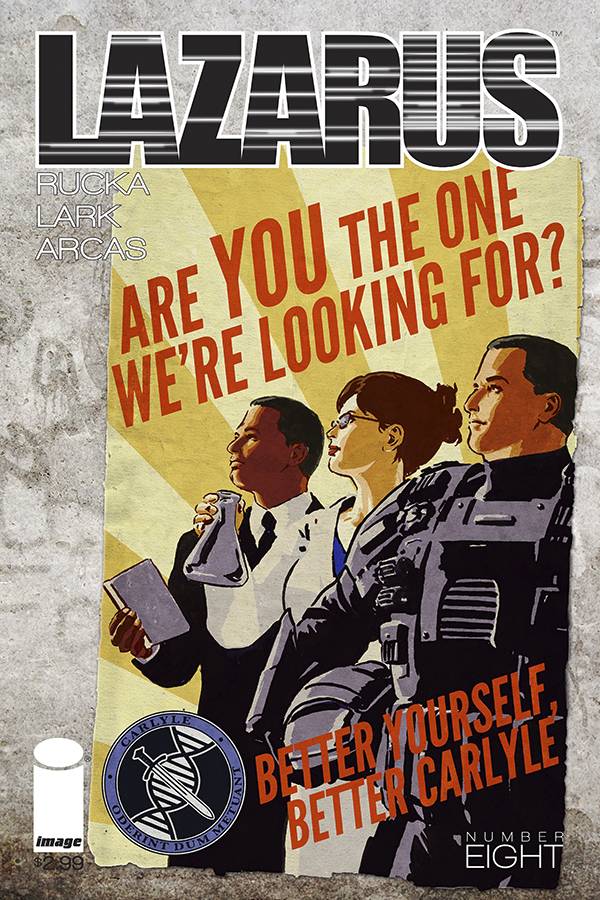
Lazarus #8

Lazarus #8

#2. Southern Bastards #1 (Image): Oh.  Shit.  Jason Aaron and Jason Latour have made quite a splash with their merciless ode to good ol’ boys.  Now, I’m predisposed to liking it because of its being not unlike Justified, with its Southern-fried setting and tone, and even its well-defined yet ambiguous cast of characters, smacking of the late, great Elmore Leonard, and, in that, the often late, great Garth Ennis–which makes even more sense considering that it also reads a hell of a lot like Fury: My War Gone By and Mark Millar’s Starlight because of the big notes of nostalgia and, tying it all together, because Latour’s Earl is plenty Parlovian.  The story’s solid from the get-go: Jason Squared pitches the prodigal son’s return and expertly upsells pathos as the conflict grows–just as a tree grows from Earl’s father’s grave–into the final sequence, itself a grueling duel of duels–a one-two combination (punishing blows received and delivered) of violent events enlivened by the lyrical layouts–that cements this debut as a top book of the month; it’s the love shown by the creators for the South and the story inspired by it that makes it even more than that.  (SC)
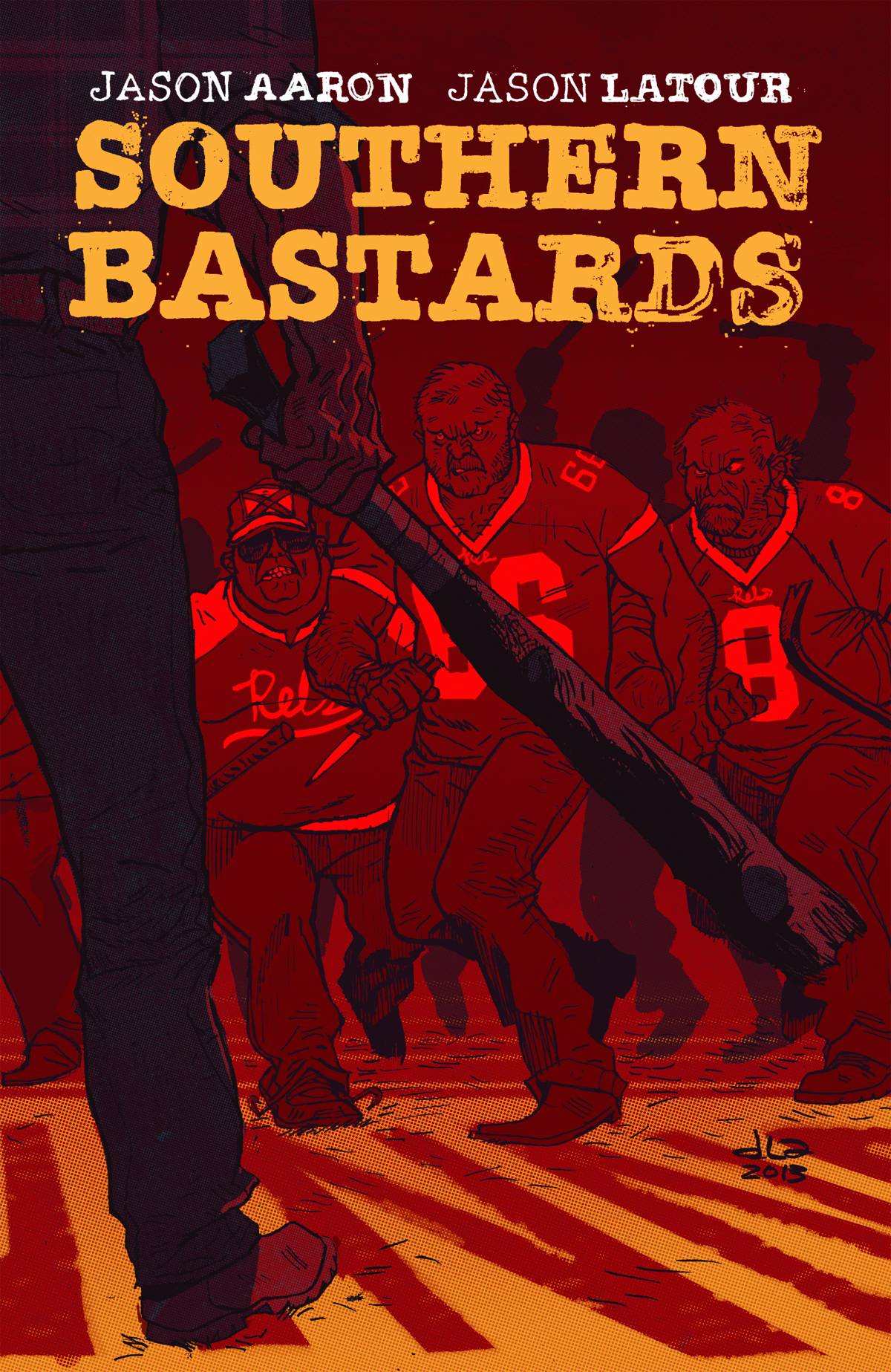
Southern Bastards #1

Southern Bastards #1

#1. The Massive #22 (Dark Horse): Thus far, Brian Wood’s apocalyptic take on Moby Dick has focused on one Callum Israel, whose Ahab-like obsession with finding his eponymous ship has led him to the far corners of a world that is slowly falling apart due to a mysterious event known as The Crash. The search has allowed Wood to explore in convincing detail (with the help of an impressive cadre of artists; here Danijel Zezelj does the honors, with Jordie Bellaire on colors) the effects of environmental devastation, economic collapse, and political disintegration in such disparate locales as Iceland, Hong Kong and Mogadishu. The sheer breadth of Wood’s geopolitical knowledge and inquiry is impressive. It also pulls off the neat trick of serving as both the series’ raison d’etre and narrative backdrop to its central mysteries: Where is the Massive? What caused The Crash?

Just as the answers have eluded the increasingly obsessive Callum (did I mention he was dying of cancer?), Wood’s writing has sometimes been frustratingly vague. Many of the arcs (all consisting of three issues) have run like this: fascinating set-up, high stakes climax, baffling denouement. While there’s something to be said for not giving the reader what they want, the considerable tension inherent in the story has sometimes been undercut by endings that seem deliberately anticlimactic, and even obtuse. Well the first issue of the latest arc, “Sahara”, finally promises some resolution, beginning with the one to the other great mystery: Where the hell has Mary been?

Mary, Callum’s lover, shipmate, and conscience of his crew, seemingly abandoned him in his time of greatest need. This issue finds her, in typical Wood fashion, smack dab in the middle of a geopolitical intrigue with real-world resonance. She’s guarding a convoy of the world’s most precious post-Crash resource: water. As the spotlight shifts to her, we begin to realize what Wood has been hinting at all along: the search for the Massive is a MacGuffin. All mysteries lead to Mary. By turns the most compassionate and the most remote, she has quietly taken on an otherworldly dimension. As we watch Mary cross the desert, now with child, one cannot help but think that as the series builds to its conclusion, Wood is countering the obsession and despair of the white whale with an almost biblical hope for salvation. (DM)

The Massive #22

The Biggest Dis(appointment): Mind MGMT #21 (Dark Horse): To truly understand this choice, you have to understand that disappointment comes from expectations not being met–and in some cases, from expectations being bitch slapped by promises unfulfilled.  In this case, we were led to believe that master storyteller Matt Kindt was going to deliver a “silent issue”; and if you we’re like me, you thought immediately to the silent issue of all silent issues: G.I. Joe #21 from Larry Hama and Steve Leialoha, which blew our minds thirty years ago–yikes!  With the poison–the potent neurotoxin nostalgia–already in the wound, what chance did this stab at a silent issue have–especially after our being rudely welcomed by word one!  Wouldn’t you know: Kindt–ever the clever creator–was playing us from the promise!  His interpretation of silent: no dialogue–which means that thoughts are fair game; and to make the game more fun, those thoughts were insightful, sure, but sometimes ironic, considering the situations in which the thoughts were, umm, thought.  So, fine, it’s “silent,” I’ll buy it–and I did buy it, blissfully ignorant and high on hope; however, while the story works well within the world of Mind MGMT, Kindt has managed to both exploit and execute my innocent expectations.  The former finds me somewhat satisfied, but it’s the latter than leaves me mostly nonplussed–and this issue as our Biggest Dis(appointment) of the month.  (SC)

Mind MGMT #21

Mind MGMT #21

Turning pages,

Scott & Derek

Share this:

  • Click to share on X (Opens in new window) X
  • Click to share on Facebook (Opens in new window) Facebook
  • Click to share on Tumblr (Opens in new window) Tumblr
  • Click to share on Reddit (Opens in new window) Reddit
  • Click to email a link to a friend (Opens in new window) Email
  • Click to share on Pinterest (Opens in new window) Pinterest
Like Loading...

I&Nterview: Danny Fingeroth

16 Tuesday Jul 2013

Posted by dmainhart in I&Nterview

≈ Leave a comment

Tags

A Contract with God, Alain Resnais, All Things Considered, Alter Ego, Chris Claremont, Danny Fingeroth, Dean Haspiel, Dennis O'Neil, Disguised as Clark Kent: Jews Comics and the Creation of the Superhero, Fredric Wertham, Harvey Pekar, Hilde Mosse, Jack Kirby, Jason, Joey Cavalieri, Klaus Janson, Last Year at Marienbad, Leila Corman, Marvel, Marvel Comics: The Untold Story, memoirs, Miriam Katin, MoCCA, NPR, Peter Kuper, Rick Geary, Robert Crumb, Roy Thomas, Sean Howe, Seth, Silver Surfer, Society of Illustrators, Spider-Man, Stan Lee, superheroes, Superman on the Couch: What Superheroes Really Tell Us about Ourselves and Our Society, The Rough Guide to Graphic Novels., The SoHo Gallery for Digital Art, The Stan Lee Universe, The Today Show, TwoMorrows Publishing, Unterzakhn, WhirlGirl, Will Eisner, Write Now!

Danny Fingeroth is a man who’s made his life in comics. Best known as the longtime editor of Marvel’s Spider-Man comics line, Danny is also something of an academic authority on the form. His impressive contributions to the underlying power of the medium include such well-received books as: Superman on the Couch: What Superheroes Really Tell Us about Ourselves and Our Society; Disguised as Clark Kent: Jews, Comics and the Creation of the Superhero; and The Rough Guide to Graphic Novels. He created and edited Write Now!, a magazine dedicated to the craft of writing comics. In a similar vein, he has taught comics-related courses at New York University, The New School and The Museum of Comic and Cartoon Art (MoCCA). He has spoken on the subject at The Smithsonian Institute and The Metropolitan Museum of Art and has appeared on NPR’s All Things Considered and The Today Show on NBC. He currently offers classes and educational programs at The SoHo Gallery for Digital Art. His most recent book (co-edited with fellow legend Roy Thomas) is The Stan Lee Universe.

Derek Mainhart: You’ve delved quite a bit into the autobiographical subtext of a lot of comics, especially regarding the original superhero comics of the early 20th Century. What got you thinking along these terms?

Danny Fingeroth: It’s something I just gravitate toward thinking about. Sure, these stories were created to generate revenue, but with that as a given, what were they about under the spandex trappings? Why THESE stories and characters, and not others?  When you start thinking about that, pretty soon you’re getting to “What were the creators—including the editors—trying to express? What personal experiences, yearnings, dreams, did they draw on?”

DM: Interesting that you mention the editors; they often get overlooked in questions like this. To what degree do you think editors influenced some of the autobiographical subtext we’re talking about?

DF: Editors often become part of the creative process, especially in mainstream comics, since you are often dealing in a shared universe. Every comic and every team deals with this differently. Ultimately, the editor is concerned with, “What will sell the most comics while also preserving the long term integrity of the main characters?” (Business imperatives may dictate how much concern is evidenced for those long term concerns.) So if a story ultimately becomes a combination of ideas and experiences from the various parties concerned in making the story, then that’s fine, at least as far as the long term health of the character franchise, if not for the egos of all concerned. Just as a TV series can be the “vision” of one or multiple minds, the same with a comics series. The editor is supposed to not take credit for the creative content, but if you find yourself liking multiple titles, on an ongoing basis, that are edited by a specific person, then you have to think that, at the very least, that editor is catalyzing these particular creators into working at the top of their game, even if he or she is not specifically directing them regarding what to do and how to do it.

DM: What would you say the comics written by Danny Fingeroth reveal about him?

DF: That’s not really for me to say. Let a thousand doctoral theses be launched! (Or at least a couple of blog posts.)

DM: On the other side of the coin, you’ve written about society’s need for superheroes. Do you think they have a shelf life? The heroic figures of the 19th Century, for example, don’t necessarily carry the same weight as they did in their own time (Sherlock Holmes being, perhaps, an exception). Even the pulp heroes that begat superheroes, while still around, are hardly the phenomena that they once were. Could it be said that, in terms of comics, the 20th Century was the Superhero Century, and that the 21st will perhaps move on to Something Else? Or have waves of blockbuster movies enshrined them in the popular consciousness?

DF: The latter. As our society seems to become more complex than ever (is that an illusion?), people tend to want simple, direct solutions to these problems in their entertainment. Superheroes, even complex ones, fill that bill. The superhero has become for the 2000s what the Western was for the 20th Century—a metaphor system through which Americans tell ourselves our collective story.

Behind the Scenes

DM: Sean Howe’s book Marvel Comics: The Untold Story recently garnered some attention. Naturally, you make a couple of appearances. Would you say his behind-the-scenes look at Marvel’s history paints an accurate picture? Is there anything in it you’d care to comment on?

DF: I’d say given the enormity of the task Sean took on, he did a good job of weaving the company’s history into a narrative with a compelling flow. There is no single “Marvel,” after all. Everyone who worked there experienced it differently. I think Sean delved into some of what was going on behind the scenes over the years with a reasonable amount of accuracy. The hardest thing to convey in a biography of a company is the reality that, while people come together at a place for a common cause, they/we all have our own non-work lives going on at the same time. That’s where personal memoirs would come in. What non-work-related reasons were there for why a particular person made a series of decisions? Who were they when they left the office for the day? How did that affect the work they produced?

DM: How do you think the job of an editor has changed in the last 15 years or so?

DF: It seems pretty much the same to me. I think the replacement of the phone call with e-mail and other electronic communication media is problematic when applied to a creative field. As in most areas of life, communication is now quicker, and while in some ways clearer, in other ways more confusing. We’re probably now at a similar point where, 100 years ago, people were bemoaning the impersonal nature of the phone call. Now we yearn for the shades of meaning that can be conveyed by an actual human voice over a phone. But the roles of an editor as representing the company to the creators and the creators to the company seem to me to be pretty constant.

DM: What about the role of an editor as representing the company and creators to the public/fan base? How important is it to have a presence on social media, for example?

DF: Social media is an accelerated, intensified version of the letters page, and convention interaction which editors and creators used to interact with the public in the pre-digital era. Readers and fans (not always the same thing) may think they want to see a particular character’s saga develop in a certain way, but the fact is that what people want is to be surprised by something that in retrospect was inevitable–which is the definition of a good story. Ultimately, in non-gaming, non-fanfic narratives, we want to see the characters we have an emotional investment in do amazing things that are awesome and cool–but that also make sense given what we know about the characters and their worlds. So social media can serve to help get a more immediate sense of what the readership likes and doesn’t like, or what surprises they may have figured out before you wanted them to–but ultimately, just as they want to hear a singer sing, they want to have the storytellers tell them the best possible stories. Social media helps that process along.  

DM: The fanboy/geek in me has to ask: the Spider-Man line is currently involved in a controversial storyline. Your run as editor on Spider-Man was no stranger to controversy itself. Is there any advice you could give to Spidey’s current editorial crew?

DF: Listen to all advice, but keep your own counsel. If the fan inside you says “I gotta read that!”—then do it!

Memoir-able

DM: In The Rough Guide to Graphic Novels, your top three choices are memoirs, and your top ten is rounded out by books that are at least partly autobiographical in nature. Is there something inherent in the medium that lends itself to this type of personal narrative?

DF: I think so. There’s something so direct and visceral about comics.  The medium can convey complexities of human experience that are simultaneously “realistic” and yet also subjective, and do it in a way that neither print nor film/video can.

DM: How much of this autobiographical strain do you think can be traced back to the “first” graphic novel, Will Eisner’s A Contract with God?

DF: I think it goes back at least as far as Crumb, who often told stories that were from his own life, and then to Harvey Pekar, who refined autobiography to a high level, often with Crumb illustrating. Eisner added a distancing layer by lightly fictionalizing his characters’ names and likenesses. Being of a different generation with a different orientation toward comics, Eisner’s stuff was a synthesis of what he had done over the previous decades, along his realization that adults who enjoyed comics might actually want material that deals with more mature themes and concerns.  Of course, storytellers have been mixing autobiography with fiction forever. Even in Contract and his other work that is considered autobiographical, Eisner is very careful to use fictional street names and somewhat disguised characters, so what seems like memoir is fictionalized.

DM: TRGtGN was published in 2008. Anything since then crack your list of must-reads?

DF: Jason and Seth are pretty fantastic. So are Miriam Katin, Dean Haspiel, and Peter Kuper. Leila Corman’s Unterzakhn was great. Rick Geary’s body of work is astonishing.

And Now for Something Completely Different…

DM: Whatever happened to WhirlGirl?

DF: She hasn’t gone away. More info when and if something happens…

Stan the Man

DM: What was the impetus behind Write Now! ?

DF: I wanted to demystify comics writing and to get it some respect. Also, I wanted people to get some sense of how it’s done and make them think about how they might be able to write comics of whatever type, for the major companies, or 20 of their friends. Art is “sexier” than writing because its appeal is visceral and often immediate, whereas writing takes a little more time and effort to judge and respond to—at least it seems that way on the surface. After all, writing and art combine to make comics, so how can you really separate the two crafts, anyway?

DM: Was putting together The Stan Lee Universe a natural outgrowth of your experience on Write Now! ?

DF: Well, it started as the simple idea to combine my and Roy Thomas’s 85th birthday tributes to Stan from Write Now and Alter Ego magazines. Then it got a whole lot more complicated when we decided that I would travel to Stan’s archives at the University of Wyoming and see what unique material I could find there. And I found lots!!

 DM: Sounds potentially fascinating. Anything you can share?

DF: I found recordings of radio interviews that were broadcast in the 1960s and then never heard again. I had the best of them transcribed and then lightly edited them, and they appear in the book. There’s a lengthy one of Stan with Jack Kirby from 1967, which is fascinating. Then there’s one from 1968, the week after Nixon was elected president, of Stan debating comics-hating Fredric Wertham’s colleague, psychiatrist Hilde Mosse, about comics and popular culture.

DM: Wow.

DF: There’re also pages from the screenplay Stan wrote in the early ’70s for a film that was to be directed by his friend, French director Alain Resnais, who made Last Year at Marienbad, among many classics, and is still making important movies.

DM: Tres avant garde

DF: Plus, there’s a lot of script and pencil art from the 1978 Silver Surfer graphic novel Lee and Kirby did, including many personal notes and comments from both of them. Those are just a few of the incredible things in the book. It’s pretty amazing stuff. I’d love to do a volume two. 

DM: Stan projects a very strong public image. Without giving anything away, did editing all of those interviews from various points in Stan’s life give you some new insight into the intersection of his life and work? The man behind the persona?

DF: I learned that he gives the world more glimpses behind that public persona than is immediately obvious, because he often couches remarkably frank statements within the context of other material that is more purely promotional or entertaining. His public persona, in my experience, isn’t that different from the private one—just louder.

From Behind the Scenes to In Front of a Blackboard

DM: The classes you put together for MoCCA over the years featured an impressive roster of talent (Chris Claremont, Dennis O’Neil, etc). Had any of them taught before?

DF: Dennis had taught for many years at SVA. Ditto for Joey Cavalieri and Klaus Janson. I think at some point most comics creators have done at least a guest shot in a class or been on a panel at a convention. For those with less teaching experience, I would do the lesson as an interview I was conducting with them. Don’t forget, in pitching a story, one uses many of the same skills a teacher uses: conveying an idea clearly and in a compelling manner to someone else. I would generally try to choose people to teach whom I knew had an engaging conversational style, and who were excited about sharing ideas. They were teaching already, even if they weren’t aware that they were.

DM: Any thoughts on MoCCA’s absorption by the Society of Illustrators?

DF: I’m glad MoCCA is surviving and thriving. I’m a big fan of both organizations.

DM: Anything else in the works?

DF: I’m working on several book and comics projects that I hope to be able to speak about in more detail soon. Ditto for events and classes that I’ll be giving live and online. I can tell you that I’ll be teaching my comics writing online class again through The Media Bistro website in the fall, and teaching a comics writing course for undergrads through the department of TV and Radio at Brooklyn College, also in the fall.

DM: What advice would you give to prospective comics creators (other than to take your classes!)?

DF: Don’t do just one thing. Be an artist, not just a comics artist. Be a writer, not just a comics writer. Comics careers are for the most part relatively short, even for people whose talent is acclaimed and in demand. Even if you have a twenty-year comics career, you still have another twenty, thirty, forty or more years of a working life in which you’ll want to stay active and productive.   


Share this:

  • Click to share on X (Opens in new window) X
  • Click to share on Facebook (Opens in new window) Facebook
  • Click to share on Tumblr (Opens in new window) Tumblr
  • Click to share on Reddit (Opens in new window) Reddit
  • Click to email a link to a friend (Opens in new window) Email
  • Click to share on Pinterest (Opens in new window) Pinterest
Like Loading...

The Nerds

  • dmainhart's avatar dmainhart
  • ScottNerd's avatar ScottNerd

Enter your email address to follow this blog and receive notifications of new posts by email.

Join 142 other subscribers

An Amazing Comic Shop

Wiggle Room

It's just the beginning...

Tag Salad!

Ales Kot All-New X-Men Animal Man Archer & Armstrong Avatar Batman Batwoman Bloodshot BOOM! Brian Azzarello Brian K. Vaughan Brian Michael Bendis Brian Wood China Mieville Chris Bachalo Chris Samnee Clone comics Cullen Bunn Daredevil Dark Horse DC DC Comics Dial H Dynamite Dynamite Entertainment Ed Brubaker Fatale Fiona Staples Fred Van Lente Garth Ennis Goran Parlov Grant Morrison Greg Rucka Harbinger IDW Image Image Comics J.H. Williams III J. Michael Straczynski Jason Aaron Jeff Lemire Jonathan Hickman Jordie Bellaire Joshua Dysart Kevin Eastman Kieron Gillen Kurt Busiek Lazarus Mark Waid Marvel Matt Fraction Matt Kindt Mike Allred Mind MGMT Nick Spencer Oni Press Rachel Rising Robert Venditti Saga Scott Snyder Sean Phillips Swamp Thing Teenage Mutant Ninja Turtles Terry Moore The Massive Titan Uber Ultimate Spider-Man Uncanny X-Men Valiant Vertigo Wonder Woman X-O Manowar zero

Archives

  • August 2022
  • March 2022
  • February 2022
  • December 2021
  • August 2020
  • November 2018
  • October 2018
  • September 2018
  • August 2018
  • July 2018
  • August 2017
  • September 2016
  • August 2016
  • July 2016
  • September 2015
  • August 2015
  • July 2015
  • June 2015
  • May 2015
  • April 2015
  • March 2015
  • February 2015
  • January 2015
  • December 2014
  • November 2014
  • October 2014
  • September 2014
  • August 2014
  • July 2014
  • June 2014
  • May 2014
  • April 2014
  • March 2014
  • February 2014
  • January 2014
  • December 2013
  • November 2013
  • October 2013
  • September 2013
  • August 2013
  • July 2013
  • June 2013
  • May 2013
  • April 2013
  • March 2013
  • February 2013
  • January 2013
  • December 2012
  • November 2012
  • October 2012
  • September 2012
  • August 2012

Features

  • 22 I&N 22
  • 5 Comics You Should Be Reading
  • Back and Forth
  • Derekommendations
  • I&N Print
  • I&N Review
  • I&N Scott's Bag
  • I&N Store
  • I&N the Gutter…
  • I&N's Top Ten
  • I&Nsight
  • I&Nterview
  • Innie Awards
  • Microviews
  • Scottlight on…
  • Superhero Friday!
  • Top 5 Books of the Month
  • Uncategorized
  • What's I&N Store?

Recent Posts

  • Creator Watch: Deniz Camp
  • The Best Comics You’re Not Reading
  • Pick of the Week
  • Best Comics of 2021
  • Worth Your Time

Real Nerdy Stuff

  • Create account
  • Log in
  • Entries feed
  • Comments feed
  • WordPress.com

Twitter Updates

Tweets by imagesandnerds

Top 3 Posts & Pages

  • Creator Watch: Deniz Camp
  • The Best Comics You're Not Reading
  • Pick of the Week

Finders Keepers

Blog at WordPress.com.

Privacy & Cookies: This site uses cookies. By continuing to use this website, you agree to their use.
To find out more, including how to control cookies, see here: Cookie Policy
  • Subscribe Subscribed
    • Images and Nerds
    • Join 57 other subscribers
    • Already have a WordPress.com account? Log in now.
    • Images and Nerds
    • Subscribe Subscribed
    • Sign up
    • Log in
    • Report this content
    • View site in Reader
    • Manage subscriptions
    • Collapse this bar
 

Loading Comments...
 

    %d