• The Big Picture
  • Here’s ScottNerd…
  • Here’s DerekNerd…

Images and Nerds

~ We're turning pages–and writing about them!

Images and Nerds

Category Archives: I&Nterview

I&Nterview: Guillermo Zubiaga

14 Monday Jul 2014

Posted by dmainhart in I&Nterview

≈ Leave a comment

Tags

Domingo de Luça, Guillermo Zubiaga, Hal Foster, Joanes de Echaniz, Joanes or The Basque Whaler, Juanes de Larrume, Michael Barkham, NY ComicCon, Prince Valiant, The Center for Basque Studies, University of Nevada, whaling

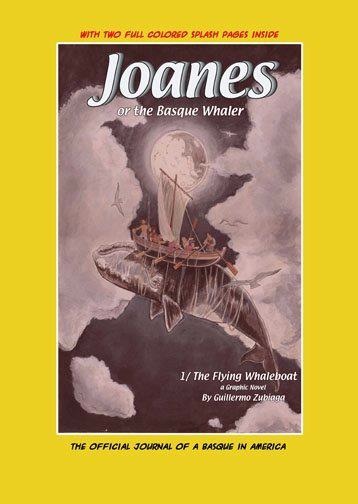
There are a lot of ways for independent creators to get published these days. You could start a Kickstarter campaign. You could publish on the web. Or, if you’re Guillermo Zubiaga, you could have it financed by scholarly cultural institutions like the University of Nevada and The Center for Basque Studies. His comic Joanes, or the Basque Whaler, has garnered him considerable attention, much of it from sources you wouldn’t normally associate with comic books.
guillermo1

 Derek Mainhart: So first a little background info: What’s your professional comics background?

Guillermo Zubiaga: I started my career working in an animation cartoon studio, while getting my degree at Syracuse University. After graduation I decided to move to New York City, to expand my professional possibilities. I got my first job in the comic book industry around 1997. I did a year or so work “ghosting” (uncredited work) and after a relatively short time I managed to get my work credited in Marvel’s X-Force. I also ghosted on Images Comics’ HellHole #1 and then on Witchblade INFINITY, for which I was given credit. 

Around the same time I also worked as a toy designer with Art Asylum, drawing designs for action-figures for ToyBIZ: X-Men, Spider-Man, Lord of the Rings and others. I also worked on the Image Comics title Nosferatu 1922 and some more ghosting for Vertigo (DC) on Big Daddy Danger, for which I was occasionally credited. I did some inking on an issue of B.P.R.D. for Dark Horse, and on an Image graphic novel, The Romp.

I have also drawn quite a few storyboards, mostly for TV-advertising, some music videos, but most notably for the short film Witchwise (2006) by Joe Harris and Night Messiah Films-Lointerscope.

DM: So you’ve been around. How did you feel about the “ghosting” process? Did it bother you to not get credited for some of your work?

GZ: I found ways around it. For example, perhaps semi-consciously, I began peppering a few subtle Basque “winks” and “tags”. Well, some not so subtle at all: there were iconic Basque symbols, letters, words, even phrases and names of Basque rock and rap bands, etc. Things I thought would not be recognized by anybody. I figured no other Basques were likely to be working as artists in the comic book industry. I never thought I was getting away with anything. If any of the camouflaged, incomprehensible Basque “winks” I drew in the background would have jumped out as any kind of red flag to an editor, the worst that could have happened was that I would’ve simply erased them and drew them over. But that never happened. On the contrary, I think that my when some of the books I worked on in America got published back in Europe, the “Basque winks” that I thought I had concealed so inconspicuously were eventually discovered. This led to some very considerable attention until finally the University of Nevada got news of my “affairs”.

DM: What was this “considerable attention”? When the University contacted you, were you already working on Joanes?

GZ: Yes. In 2007 I finished the flying whaleboat, showed it around to different editors in NYC and throughout the Comic Con circuit, trying to find a suitable venue.  I gave myself a self-imposed deadline of one year to find somebody to publish it. If not, I’d try self-publishing it.

During this time several articles were published about it in just about all the newspapers back in the Basque Country. I also was invited to participate in several interviews in a couple of Basque Radio shows and featured in a small piece on Basque News television.

A few months before my self-imposed deadline to find somebody to publish my book, I received a call from the University of Nevada, Reno. In 2009, courtesy of their Center of Basque Studies I published Episode 1 of my Joanes or the Basque Whaler saga: The Flying Whaleboat.

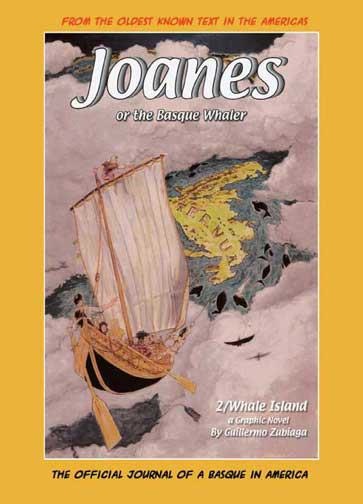
The second installment of the Basque whaling trilogy, Whale Island, premiered two years later at NY COMICON.
guillermo2

DM: What part did the University and the Center for Basque Studies play in publishing/promoting the book?

GZ: The Center for Basque Studies of the University of Nevada, in Reno holds and publishes (for the last 50 or so years and counting) the largest Basque themed library in the world (outside of the Basque country). So it has been, along with its vast distribution network, pivotal in spearheading this project and making it a reality.

I want to think of it as having been the right fit, and in retrospective I think I wouldn’t have wanted it any other way.

DM: What can you tell us about the story?

GZ: I would describe it as a fictional epic scattered with Basque mythological references. Regarding the first volume, Joanes, the protagonist, tries to make his fortune as a whaler during an era when the whales in the Bay of Biscay were becoming scarce. He’s forced to look farther afield, but without the means to do so. Here is when the story begins to depart from historical fact and the narrative weaves in elements of Basque legend. With the help of witches, Joanes summons a sea-devil who assist him…But for a price!

The episode ends with danger hanging over the recent success of Joanes and his crew as he has to live up to his unhallowed pact.

As far as the second book goes, continuing with the idea of Joanes as an anti-hero, we see that his fame and fortune grow, but so does his notoriety as a blasphemous and impious drunk. This defect will ultimately become his downfall, something quite real, human and flawed, characteristically lacking in most heroes.

This volume represents a turning point in the narrative: it’s the point of highest tension, before the conclusion in #3.

DM: The story takes great pains to recreate 15th century whaling practices. What interested you about the subject?

GZ: I hold the entire framework to be genuinely a Basque Western genre, comparable to The Cowboy in America, The Samurai in Japan or The Viking in Scandinavia. A truly epic age for the Basque people, which to quote a friend of mine “was the time when Basques have shined the brightest in their history”.

We Basques have been sitting on a buried treasure. As luck would have it, in our lifetime we have had the opportunity to discover the oldest and best preserved wreckage from the exploration age in the world. Not to mention two of the oldest written documents in American history, acknowledging us with the verifiable truth to claim back such a historical and cultural wealth.

DM: In addition to the whaling stuff, the narrative teems with historical detail. How much research did you have to do? Can you tell us about the process?

GZ: Research indeed!! I believe that the success of anything you do in this life depends 90% on research. It wasn’t easy, especially since not all investigating, in terms of archeological study, was done when I began this project. I realized that there wasn’t a whole lot to be found, although I am quite a library mouse and as much as I like to research, I had to talk to quite a lot of people. It wasn’t easy. I remember I went to different academic and cultural museums in the Basque Country as well as in Canada and Iceland, requesting any kind of visual aid, but like I said there wasn’t much. Luckily today I would say the field itself seems to be experimenting a bit of a revival.

DM: The story has the feel of folklore about it. How much derives from Basque tradition and how much is purely invention?

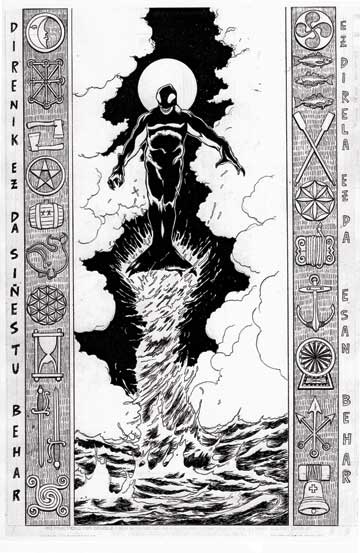
GZ: As far as the narrative is concerned, with the exception of personifying the natural occurrence of the Traganarroo (“watersprout” in Basque) into an anthropomorphic killer whale, I have painstakingly gathered every single element from the vast Basque mythological tradition; the witches and their relationship with the sea as well as the night whaleboat air rides, etc. I also drew from a very rich (though often little known) maritime history. The way I see it, all the elements were already there I just had to find them and weave them in a cohesive way that made them all fit.
guillermo3

the Traganarroo

DM: You incorporate text and symbols into some of your page design. Considering your penchant for hidden “winks”, are these meant to provide added layers of meaning?

GZ: Well of course! One would only hope those “added layers of meaning” are deciphered. However, unlike my days of ghosting, where my Basque winks were somewhat unpremeditated, every element in JOANES is fully planned.

DM: The overall storytelling approach, episodic in nature, with an omniscient narrator, reads less like a traditional comic and more like a heavily illustrated narrative. In fact, the combination of this approach with your exhaustive attention to detail and realistic rendering style put me in the mind of nothing so much as Hal Foster’s work on Price Valiant. Was this approach dictated by the type of story you’re telling? Why did you choose this method?

GZ: Right off the bat, thanks for that reference to “the Prince of Illustrators”! I am not sure if I could explain my method or how I choose it; however I knew from the very beginning that I wanted to do something “different”, with a clear conscious effort along the way that I wanted to avoid most (if not all) cliches, narrative as well as visual. Yet I also knew I wanted something done with a traditional feel, especially if we consider the atavistic nature of the subject matter. I even considered doing it in sepia tone as opposed to B&W to give it a weathered look, although I do think the current print works fine.

DM: There is some interesting conjecture in the story concerning the Basque’s discovery of the New World (you even provide some historical footnotes to this effect). What evidence you find supporting this? And was this part of the impetus for the story?

GZ: Impetus for the story? You bet!! There is a whole lot of undisputed evidence on the early presence of Basques in the New world. The tale itself is inspired by two of the oldest known texts to be produced in North America, the last will and testaments of Juanes de Larrume and Joanes de Echaniz, Basque whalers who respectively died in Canada in the years 1577 and 1584. ( A recent discovery by Michael Barkham places Domingo de Luça, also a Basque Seaman, who died in 1563, as the oldest written document in North America). Along with these written documents, the oldest shipwreck found north of Florida is the Basque Galleon, San Juan.

Furthermore a recent discovery (it happened while I was wrapping #3) at a Huron village site near Toronto, places one of the oldest pieces of iron (an axe fragment) in North America. The item was radio carboned to be from around 1500 A.D. and it has yielded very suggestive results because not only does it turn out it is Basque in origin but forensic archeologists were even able to locate the actual forge where it was manufactured back in the old B.C. (Basque Country).

In 1497 A.D. when Giovanni Caboto sailed for the King Herny VIII of England and “discovered” Newfoundland, on his arrival to the New World he encountered several Basque ships already fishing its coast.

Later in 1534 A.D. as Jacques Cartier explored the east coast of Canada on his “discovery” expedition for France, he also reported seeing Basque whalers off its shores. Moreover, some of the French-Basque crew that Cartier brought with him were the only ones who could understand a few trade words that the natives were using. An Algonquin-Basque pidgin had developed over years of trade between the two groups. Modern Micmacs today claim that when both Cartier and Cabot were first encountered they were greeted in Basque. The Basque language was without a doubt one of the earliest European languages that the natives learned, before, English, French or Spanish.

You see the whole subject of Basque whaling shrouded in a halo of mystery. Besides working so far from their home ports, they were exempt from many taxes that the crown or the church would otherwise claim, so naturally the occupation itself was quite secretive, in the nature of the fisherman who keeps quiet about the source of its catch to protect him from his competitors.

At any rate, all these elements were like a jewel for at least the backdrop of the centerpiece for a narrative work.

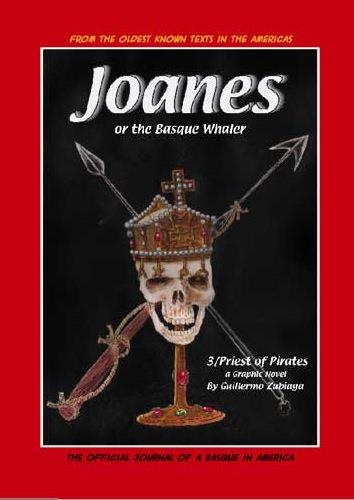
DM: The second issue ended on a note of almost biblical proportions. What can you tell us about Joanes #3?

GZ: The whole narrative of Joanes could be described as a journey of self discovery where the protagonist begins as a clear cut anti-hero but events transpire which transform him into a more traditional hero. Self sacrifice comes into play in this last issue, but even though the character appears more benign, the inner scoundrel never fully disappears.

The only two things that I can reveal is that our character has himself ordained and in addition to that becomes a pirate!!! (hence the title, Priest of Pirates)!
guillermo4

Look for Joanes or the Basque Whaler on Guillermo Zubiaga’s Blog:

http://guillermozubiaga.blogspot.com/


Share this:

  • Click to share on X (Opens in new window) X
  • Click to share on Facebook (Opens in new window) Facebook
  • Click to share on Tumblr (Opens in new window) Tumblr
  • Click to share on Reddit (Opens in new window) Reddit
  • Click to email a link to a friend (Opens in new window) Email
  • Click to share on Pinterest (Opens in new window) Pinterest
Like Loading...

I&Nterview: Danny Fingeroth

16 Tuesday Jul 2013

Posted by dmainhart in I&Nterview

≈ Leave a comment

Tags

A Contract with God, Alain Resnais, All Things Considered, Alter Ego, Chris Claremont, Danny Fingeroth, Dean Haspiel, Dennis O'Neil, Disguised as Clark Kent: Jews Comics and the Creation of the Superhero, Fredric Wertham, Harvey Pekar, Hilde Mosse, Jack Kirby, Jason, Joey Cavalieri, Klaus Janson, Last Year at Marienbad, Leila Corman, Marvel, Marvel Comics: The Untold Story, memoirs, Miriam Katin, MoCCA, NPR, Peter Kuper, Rick Geary, Robert Crumb, Roy Thomas, Sean Howe, Seth, Silver Surfer, Society of Illustrators, Spider-Man, Stan Lee, superheroes, Superman on the Couch: What Superheroes Really Tell Us about Ourselves and Our Society, The Rough Guide to Graphic Novels., The SoHo Gallery for Digital Art, The Stan Lee Universe, The Today Show, TwoMorrows Publishing, Unterzakhn, WhirlGirl, Will Eisner, Write Now!

Danny Fingeroth is a man who’s made his life in comics. Best known as the longtime editor of Marvel’s Spider-Man comics line, Danny is also something of an academic authority on the form. His impressive contributions to the underlying power of the medium include such well-received books as: Superman on the Couch: What Superheroes Really Tell Us about Ourselves and Our Society; Disguised as Clark Kent: Jews, Comics and the Creation of the Superhero; and The Rough Guide to Graphic Novels. He created and edited Write Now!, a magazine dedicated to the craft of writing comics. In a similar vein, he has taught comics-related courses at New York University, The New School and The Museum of Comic and Cartoon Art (MoCCA). He has spoken on the subject at The Smithsonian Institute and The Metropolitan Museum of Art and has appeared on NPR’s All Things Considered and The Today Show on NBC. He currently offers classes and educational programs at The SoHo Gallery for Digital Art. His most recent book (co-edited with fellow legend Roy Thomas) is The Stan Lee Universe.

Derek Mainhart: You’ve delved quite a bit into the autobiographical subtext of a lot of comics, especially regarding the original superhero comics of the early 20th Century. What got you thinking along these terms?

Danny Fingeroth: It’s something I just gravitate toward thinking about. Sure, these stories were created to generate revenue, but with that as a given, what were they about under the spandex trappings? Why THESE stories and characters, and not others?  When you start thinking about that, pretty soon you’re getting to “What were the creators—including the editors—trying to express? What personal experiences, yearnings, dreams, did they draw on?”

DM: Interesting that you mention the editors; they often get overlooked in questions like this. To what degree do you think editors influenced some of the autobiographical subtext we’re talking about?

DF: Editors often become part of the creative process, especially in mainstream comics, since you are often dealing in a shared universe. Every comic and every team deals with this differently. Ultimately, the editor is concerned with, “What will sell the most comics while also preserving the long term integrity of the main characters?” (Business imperatives may dictate how much concern is evidenced for those long term concerns.) So if a story ultimately becomes a combination of ideas and experiences from the various parties concerned in making the story, then that’s fine, at least as far as the long term health of the character franchise, if not for the egos of all concerned. Just as a TV series can be the “vision” of one or multiple minds, the same with a comics series. The editor is supposed to not take credit for the creative content, but if you find yourself liking multiple titles, on an ongoing basis, that are edited by a specific person, then you have to think that, at the very least, that editor is catalyzing these particular creators into working at the top of their game, even if he or she is not specifically directing them regarding what to do and how to do it.

DM: What would you say the comics written by Danny Fingeroth reveal about him?

DF: That’s not really for me to say. Let a thousand doctoral theses be launched! (Or at least a couple of blog posts.)

DM: On the other side of the coin, you’ve written about society’s need for superheroes. Do you think they have a shelf life? The heroic figures of the 19th Century, for example, don’t necessarily carry the same weight as they did in their own time (Sherlock Holmes being, perhaps, an exception). Even the pulp heroes that begat superheroes, while still around, are hardly the phenomena that they once were. Could it be said that, in terms of comics, the 20th Century was the Superhero Century, and that the 21st will perhaps move on to Something Else? Or have waves of blockbuster movies enshrined them in the popular consciousness?

DF: The latter. As our society seems to become more complex than ever (is that an illusion?), people tend to want simple, direct solutions to these problems in their entertainment. Superheroes, even complex ones, fill that bill. The superhero has become for the 2000s what the Western was for the 20th Century—a metaphor system through which Americans tell ourselves our collective story.

Behind the Scenes

DM: Sean Howe’s book Marvel Comics: The Untold Story recently garnered some attention. Naturally, you make a couple of appearances. Would you say his behind-the-scenes look at Marvel’s history paints an accurate picture? Is there anything in it you’d care to comment on?

DF: I’d say given the enormity of the task Sean took on, he did a good job of weaving the company’s history into a narrative with a compelling flow. There is no single “Marvel,” after all. Everyone who worked there experienced it differently. I think Sean delved into some of what was going on behind the scenes over the years with a reasonable amount of accuracy. The hardest thing to convey in a biography of a company is the reality that, while people come together at a place for a common cause, they/we all have our own non-work lives going on at the same time. That’s where personal memoirs would come in. What non-work-related reasons were there for why a particular person made a series of decisions? Who were they when they left the office for the day? How did that affect the work they produced?

DM: How do you think the job of an editor has changed in the last 15 years or so?

DF: It seems pretty much the same to me. I think the replacement of the phone call with e-mail and other electronic communication media is problematic when applied to a creative field. As in most areas of life, communication is now quicker, and while in some ways clearer, in other ways more confusing. We’re probably now at a similar point where, 100 years ago, people were bemoaning the impersonal nature of the phone call. Now we yearn for the shades of meaning that can be conveyed by an actual human voice over a phone. But the roles of an editor as representing the company to the creators and the creators to the company seem to me to be pretty constant.

DM: What about the role of an editor as representing the company and creators to the public/fan base? How important is it to have a presence on social media, for example?

DF: Social media is an accelerated, intensified version of the letters page, and convention interaction which editors and creators used to interact with the public in the pre-digital era. Readers and fans (not always the same thing) may think they want to see a particular character’s saga develop in a certain way, but the fact is that what people want is to be surprised by something that in retrospect was inevitable–which is the definition of a good story. Ultimately, in non-gaming, non-fanfic narratives, we want to see the characters we have an emotional investment in do amazing things that are awesome and cool–but that also make sense given what we know about the characters and their worlds. So social media can serve to help get a more immediate sense of what the readership likes and doesn’t like, or what surprises they may have figured out before you wanted them to–but ultimately, just as they want to hear a singer sing, they want to have the storytellers tell them the best possible stories. Social media helps that process along.  

DM: The fanboy/geek in me has to ask: the Spider-Man line is currently involved in a controversial storyline. Your run as editor on Spider-Man was no stranger to controversy itself. Is there any advice you could give to Spidey’s current editorial crew?

DF: Listen to all advice, but keep your own counsel. If the fan inside you says “I gotta read that!”—then do it!

Memoir-able

DM: In The Rough Guide to Graphic Novels, your top three choices are memoirs, and your top ten is rounded out by books that are at least partly autobiographical in nature. Is there something inherent in the medium that lends itself to this type of personal narrative?

DF: I think so. There’s something so direct and visceral about comics.  The medium can convey complexities of human experience that are simultaneously “realistic” and yet also subjective, and do it in a way that neither print nor film/video can.

DM: How much of this autobiographical strain do you think can be traced back to the “first” graphic novel, Will Eisner’s A Contract with God?

DF: I think it goes back at least as far as Crumb, who often told stories that were from his own life, and then to Harvey Pekar, who refined autobiography to a high level, often with Crumb illustrating. Eisner added a distancing layer by lightly fictionalizing his characters’ names and likenesses. Being of a different generation with a different orientation toward comics, Eisner’s stuff was a synthesis of what he had done over the previous decades, along his realization that adults who enjoyed comics might actually want material that deals with more mature themes and concerns.  Of course, storytellers have been mixing autobiography with fiction forever. Even in Contract and his other work that is considered autobiographical, Eisner is very careful to use fictional street names and somewhat disguised characters, so what seems like memoir is fictionalized.

DM: TRGtGN was published in 2008. Anything since then crack your list of must-reads?

DF: Jason and Seth are pretty fantastic. So are Miriam Katin, Dean Haspiel, and Peter Kuper. Leila Corman’s Unterzakhn was great. Rick Geary’s body of work is astonishing.

And Now for Something Completely Different…

DM: Whatever happened to WhirlGirl?

DF: She hasn’t gone away. More info when and if something happens…

Stan the Man

DM: What was the impetus behind Write Now! ?

DF: I wanted to demystify comics writing and to get it some respect. Also, I wanted people to get some sense of how it’s done and make them think about how they might be able to write comics of whatever type, for the major companies, or 20 of their friends. Art is “sexier” than writing because its appeal is visceral and often immediate, whereas writing takes a little more time and effort to judge and respond to—at least it seems that way on the surface. After all, writing and art combine to make comics, so how can you really separate the two crafts, anyway?

DM: Was putting together The Stan Lee Universe a natural outgrowth of your experience on Write Now! ?

DF: Well, it started as the simple idea to combine my and Roy Thomas’s 85th birthday tributes to Stan from Write Now and Alter Ego magazines. Then it got a whole lot more complicated when we decided that I would travel to Stan’s archives at the University of Wyoming and see what unique material I could find there. And I found lots!!

 DM: Sounds potentially fascinating. Anything you can share?

DF: I found recordings of radio interviews that were broadcast in the 1960s and then never heard again. I had the best of them transcribed and then lightly edited them, and they appear in the book. There’s a lengthy one of Stan with Jack Kirby from 1967, which is fascinating. Then there’s one from 1968, the week after Nixon was elected president, of Stan debating comics-hating Fredric Wertham’s colleague, psychiatrist Hilde Mosse, about comics and popular culture.

DM: Wow.

DF: There’re also pages from the screenplay Stan wrote in the early ’70s for a film that was to be directed by his friend, French director Alain Resnais, who made Last Year at Marienbad, among many classics, and is still making important movies.

DM: Tres avant garde

DF: Plus, there’s a lot of script and pencil art from the 1978 Silver Surfer graphic novel Lee and Kirby did, including many personal notes and comments from both of them. Those are just a few of the incredible things in the book. It’s pretty amazing stuff. I’d love to do a volume two. 

DM: Stan projects a very strong public image. Without giving anything away, did editing all of those interviews from various points in Stan’s life give you some new insight into the intersection of his life and work? The man behind the persona?

DF: I learned that he gives the world more glimpses behind that public persona than is immediately obvious, because he often couches remarkably frank statements within the context of other material that is more purely promotional or entertaining. His public persona, in my experience, isn’t that different from the private one—just louder.

From Behind the Scenes to In Front of a Blackboard

DM: The classes you put together for MoCCA over the years featured an impressive roster of talent (Chris Claremont, Dennis O’Neil, etc). Had any of them taught before?

DF: Dennis had taught for many years at SVA. Ditto for Joey Cavalieri and Klaus Janson. I think at some point most comics creators have done at least a guest shot in a class or been on a panel at a convention. For those with less teaching experience, I would do the lesson as an interview I was conducting with them. Don’t forget, in pitching a story, one uses many of the same skills a teacher uses: conveying an idea clearly and in a compelling manner to someone else. I would generally try to choose people to teach whom I knew had an engaging conversational style, and who were excited about sharing ideas. They were teaching already, even if they weren’t aware that they were.

DM: Any thoughts on MoCCA’s absorption by the Society of Illustrators?

DF: I’m glad MoCCA is surviving and thriving. I’m a big fan of both organizations.

DM: Anything else in the works?

DF: I’m working on several book and comics projects that I hope to be able to speak about in more detail soon. Ditto for events and classes that I’ll be giving live and online. I can tell you that I’ll be teaching my comics writing online class again through The Media Bistro website in the fall, and teaching a comics writing course for undergrads through the department of TV and Radio at Brooklyn College, also in the fall.

DM: What advice would you give to prospective comics creators (other than to take your classes!)?

DF: Don’t do just one thing. Be an artist, not just a comics artist. Be a writer, not just a comics writer. Comics careers are for the most part relatively short, even for people whose talent is acclaimed and in demand. Even if you have a twenty-year comics career, you still have another twenty, thirty, forty or more years of a working life in which you’ll want to stay active and productive.   


Share this:

  • Click to share on X (Opens in new window) X
  • Click to share on Facebook (Opens in new window) Facebook
  • Click to share on Tumblr (Opens in new window) Tumblr
  • Click to share on Reddit (Opens in new window) Reddit
  • Click to email a link to a friend (Opens in new window) Email
  • Click to share on Pinterest (Opens in new window) Pinterest
Like Loading...

I&Nterview: Escape Pod Comics

18 Monday Feb 2013

Posted by dmainhart in I&Nterview

≈ 1 Comment

Tags

Aardvarks Over UK, art, Austen, Cerebus, Comic shops, comics, Cynthia von Buhler, Dave Sims, Dickens, Downton Abbey, Escape Pod Comics, Hugo, Huntington, Huntington Arts Council, J.M. DeMatties, Lucy Knisley, Maus, Menachem Luchins, Page 45, Rocketship Comics, Sailor Twain, Sondheim

Escape Pod Comics, in Huntington, NY, provides an interesting take on the traditional comics shop. In fact, it’s owner, Menachem Luchins, proclaims it “the future of comic book stores.” We took some time to ask Menachem about his vision:

Derek Mainhart: So, Menachem, what’s the concept behind Escape Pod Comics?

Menachem Luchins: The concept behind Escape Pod is that there is a comic for everyone. Despite the fact that comics are becoming more and more popular, people still see them as a niche medium. They think all comics are super-heroes, or at least fantastical. While that may be a small majority of the books there really is something for every taste and age group.

More than just believing in this, we want the FEEL of Escape Pod to reflect it. That’s why if you walk in to our shop you’ll see books by genre, a HUGE kid’s section, chairs and table for reading and a whole slew of discounted used books. We want you to browse, to be comfortable. We also want to educate and investigate, which is why we’ll be offering classes and events on how comics work.

DM: Where did the idea for this kind of store come from? Give us some background info.

ML: Well, for a few years I used to travel from upstate NY to Brooklyn just so I could shop at Rocketship Comics on Smith Street. When they closed I actually cried. I also bought out a lot of their stock and fixtures, including a spinner rack of my own. I used to joke about opening my own store with all the stuff I bought from them. A year later, I was re-reading Dave Sim’s Cerebus but this time with all the letters, articles, etc and came across Mark Simpson and Stephen Holland’s manifesto for their store Page 45, which they created after putting together the Aardvarks Over UK tour for Dave and Gerhard and something just clicked… Here I was, commuting to a teaching job that I was just too burnt out to enjoy and these guys were talking about selling comics to EVERYONE. A year later I went for it and here we are.

DM: Ah yes, I know the pain of losing a beloved store. Which brings me to another question: You’re opening up a comics store?! In this economy?! Are you crazy?!!!

ML: Well, the simplistic answer is that I’m not looking to strike it rich or even make “a lot” of money, I’m just planning on making enough to get by (with a wife and three kids…). I’ve never really been a very money-centric guy. If I was, I could tell you how comics are the only print medium that actually had INCREASED sales in the last year, how people buy entertainment and escapist works MORE in a recession. I would point out that thanks to the economy, a 90-minute movie costs about what a 200+ page comic costs and that a paperback novel is closing in on that price-point as well. I could also, getting off the money issue, go on and on about smart buying as a store and how our cultural events, classes and signings are going to make us much more than just a shop, but a community center. All of that is an explanation but none of it is really the answer. The real answer, honestly, is a combination of all those things and many more. But to more directly and succinctly answer your question: Yes, I’m crazy.

DM: Heh. Tell us a little bit about the classes you’re offering.

ML: Funny you should ask… We’ve got the incomparable Derek Mainhart lined up to do some classes.

DM: That guy’s a hack.

ML: My current plan for that is to give Derek the store space every Saturday. Space will be cleared and he will be free to teach however many classes he wants, or bring in other people to teach at the same time or at different times, whichever. We don’t have a firm date on this, but we’re looking at the summer.

Until then I’m going to be calling in some chips: the legendary comic writer J.M. DeMatties has already agreed to give a lecture or class one day.  So has Lucy Knisley. Cynthia von Buhler, who is kind of my patron saint, has agreed to come down for something, and to sell some of her comic’s original art through us.

Just today, a gentleman who wandered in, insisting he didn’t read comic books but was wondering if I sold “illustrated novels, like Maus,” suggested that I teach a literature class for adults once a month. When people wander in off the street I like to give them my full attention; since the store doesn’t really need anything immediately, I’m able to explain my plans and goal better and just chat.

Chatting with this guy and his wife led us all over: from Downton Abbey to Hugo to Dickens to Austen to Sondheim… After which, he made that suggestion. I insisted that it would have to be a comic class, but could easily be a literary one. He was all for it, was ready to sign up then and there. His wife too. Hmmm… Sailor Twain, maybe?

DM: Sounds like an impressive lineup (other than that Mainhart guy). You also mentioned hosting “cultural events.”  What sorts of things do you have in mind? Anything in the works?

ML: Well, I’m currently working with the Huntington Arts Council on their exciting Spark Boom program, which is starting in spring and running until the end of the summer. There are going to be all sorts of events at various locales and stores in the area and we may even be hosting a few in the store.

Aside from that, I’m talking to some artists (none very firm yet) about doing small shows in our space. There are also lectures planned to educate the average person on what exactly comics are. After all, they’re not just for kids anymore…

DM: Amen to that! So, education, lectures, art exhibits: sounds like you really want to be part of the local community. To paraphrase Homer (Simpson): Is there anything Escape Pod Comics can’t do?

ML: Well, we won’t be selling toys or t-shirts… So there’s that. Frankly, a good book store, whether it’s solely devoted to just comics or to the written word or both, SHOULD be all those things. In recent years the Internet and franchises have destroyed the literally thousands of stores that used to exist like this all across the USA. Our goal is to bring the comfort of a joyous shopping experience at a place that knows you, your town and your interests, back. But I guess you’ll have to stop in to the store to see if we’ve been successful.

Escape Pod Comics. Check it out.

Share this:

  • Click to share on X (Opens in new window) X
  • Click to share on Facebook (Opens in new window) Facebook
  • Click to share on Tumblr (Opens in new window) Tumblr
  • Click to share on Reddit (Opens in new window) Reddit
  • Click to email a link to a friend (Opens in new window) Email
  • Click to share on Pinterest (Opens in new window) Pinterest
Like Loading...

The Nerds

  • dmainhart's avatar dmainhart
  • ScottNerd's avatar ScottNerd

Enter your email address to follow this blog and receive notifications of new posts by email.

Join 142 other subscribers

An Amazing Comic Shop

Wiggle Room

It's just the beginning...

Tag Salad!

Ales Kot All-New X-Men Animal Man Archer & Armstrong Avatar Batman Batwoman Bloodshot BOOM! Brian Azzarello Brian K. Vaughan Brian Michael Bendis Brian Wood China Mieville Chris Bachalo Chris Samnee Clone comics Cullen Bunn Daredevil Dark Horse DC DC Comics Dial H Dynamite Dynamite Entertainment Ed Brubaker Fatale Fiona Staples Fred Van Lente Garth Ennis Goran Parlov Grant Morrison Greg Rucka Harbinger IDW Image Image Comics J.H. Williams III J. Michael Straczynski Jason Aaron Jeff Lemire Jonathan Hickman Jordie Bellaire Joshua Dysart Kevin Eastman Kieron Gillen Kurt Busiek Lazarus Mark Waid Marvel Matt Fraction Matt Kindt Mike Allred Mind MGMT Nick Spencer Oni Press Rachel Rising Robert Venditti Saga Scott Snyder Sean Phillips Swamp Thing Teenage Mutant Ninja Turtles Terry Moore The Massive Titan Uber Ultimate Spider-Man Uncanny X-Men Valiant Vertigo Wonder Woman X-O Manowar zero

Archives

  • August 2022
  • March 2022
  • February 2022
  • December 2021
  • August 2020
  • November 2018
  • October 2018
  • September 2018
  • August 2018
  • July 2018
  • August 2017
  • September 2016
  • August 2016
  • July 2016
  • September 2015
  • August 2015
  • July 2015
  • June 2015
  • May 2015
  • April 2015
  • March 2015
  • February 2015
  • January 2015
  • December 2014
  • November 2014
  • October 2014
  • September 2014
  • August 2014
  • July 2014
  • June 2014
  • May 2014
  • April 2014
  • March 2014
  • February 2014
  • January 2014
  • December 2013
  • November 2013
  • October 2013
  • September 2013
  • August 2013
  • July 2013
  • June 2013
  • May 2013
  • April 2013
  • March 2013
  • February 2013
  • January 2013
  • December 2012
  • November 2012
  • October 2012
  • September 2012
  • August 2012

Features

  • 22 I&N 22
  • 5 Comics You Should Be Reading
  • Back and Forth
  • Derekommendations
  • I&N Print
  • I&N Review
  • I&N Scott's Bag
  • I&N Store
  • I&N the Gutter…
  • I&N's Top Ten
  • I&Nsight
  • I&Nterview
  • Innie Awards
  • Microviews
  • Scottlight on…
  • Superhero Friday!
  • Top 5 Books of the Month
  • Uncategorized
  • What's I&N Store?

Recent Posts

  • Creator Watch: Deniz Camp
  • The Best Comics You’re Not Reading
  • Pick of the Week
  • Best Comics of 2021
  • Worth Your Time

Real Nerdy Stuff

  • Create account
  • Log in
  • Entries feed
  • Comments feed
  • WordPress.com

Twitter Updates

Tweets by imagesandnerds

Top 3 Posts & Pages

  • Creator Watch: Deniz Camp
  • The Best Comics You're Not Reading
  • Pick of the Week

Finders Keepers

Create a free website or blog at WordPress.com.

Privacy & Cookies: This site uses cookies. By continuing to use this website, you agree to their use.
To find out more, including how to control cookies, see here: Cookie Policy
  • Subscribe Subscribed
    • Images and Nerds
    • Join 57 other subscribers
    • Already have a WordPress.com account? Log in now.
    • Images and Nerds
    • Subscribe Subscribed
    • Sign up
    • Log in
    • Report this content
    • View site in Reader
    • Manage subscriptions
    • Collapse this bar
 

Loading Comments...
 

    %d